

Residential Pest Control
Starting from
$49 /mo
Ants, roaches, spiders, scorpions, crickets, wasps, fleas, ticks. Quarterly Zero Gap treatment™, the foundation of Forterra's treatment plan.
Learn more about residential pest control →Whenever something turns up between visits, re-treatment is free, and the first visit closes the entry points pests use. Ongoing pest control in Cross Roads also treats the inside and outside of your home through the year.
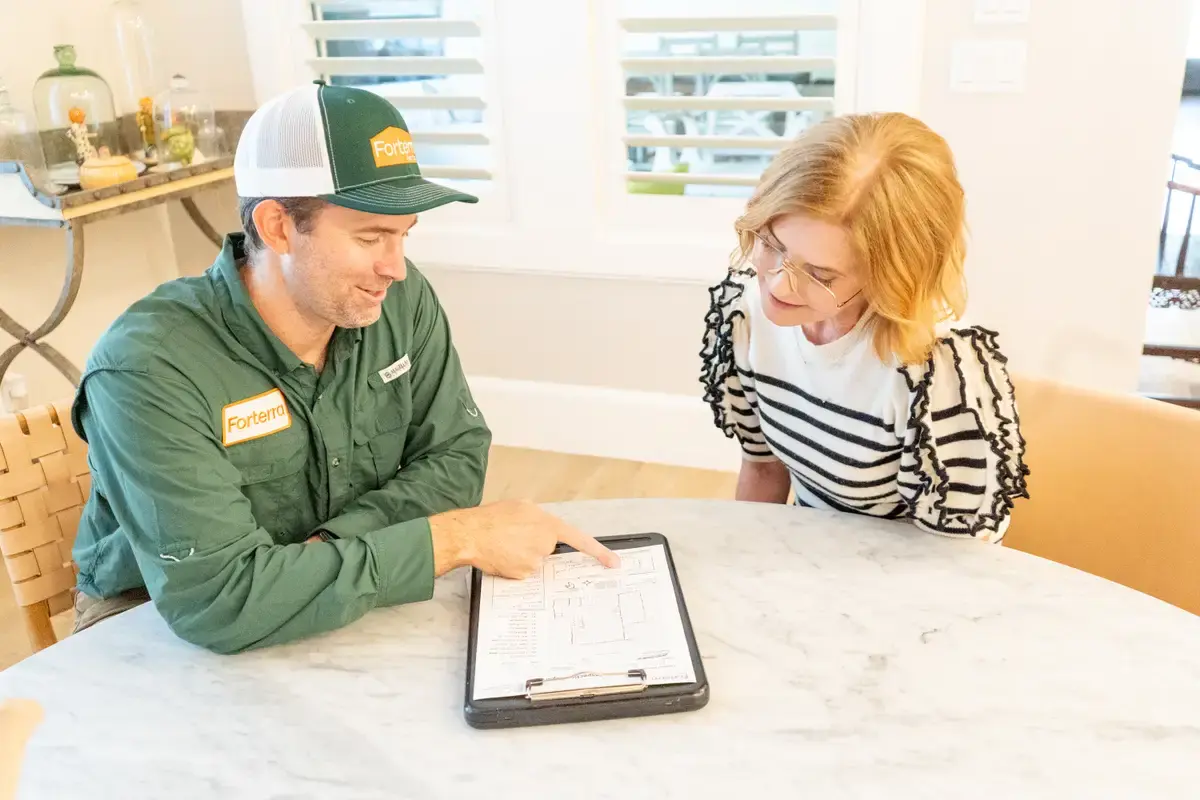
Wide lots put your Cross Roads home closer to open ground than to a neighbor, so pressure arrives seasonally across that ground rather than steadily along a fence. Forterra times the work to the surrounding land instead of a fixed calendar. Entry points close with the Zero Gap System™. Licensed TPCL #850046, backed by the Forterra money-back guarantee.
"Ryan was amazing. Took care of a long-standing problem that we tried to eradicate on our own. Even found massive ant colonies that we couldn’t see after multiple mows. Thank you for your help! We can walk with ease around our home again."
"Everything went well and Drake was very friendly. Looking forward to future appointments with this company. Thank you!"
"We are very happy with you service"
"Good service"
"Cobie provided excellent service! He was helpful, thorough, and professional! I would definitely recommend him as a technician!"
"Chad did an exceptional job."
76227 takes in Cross Roads along with its 380-corridor neighbors, ranch stretches and new sections alike. We sort out addresses the map apps garble out here at (817) 670-2835 in one conversation, and pricing runs on measurements, house plus grounds, with the three-mile proximity to the office worth exactly nothing on the invoice. Close by, priced identically, held to standard.
Three miles separate Cross Roads from the Aubrey office, practically shouting distance, covered since 2026 with Cross Roads households woven through the 343 reviews holding ★ 5.0. That range makes windows precise and free returns nearly immediate, and the crew knows every pond, section and fence line out here the way people know their own street.
Most DFW pest companies hide prices to size you up. We don't. Here's what our four core services cost, no hidden surprises. A 12-month plan takes about $200 off your first service, or go month to month at the full first-service price. We do one-time treatments too.
Ants, roaches, spiders, scorpions, crickets, wasps, fleas, ticks. Quarterly Zero Gap treatment™, the foundation of Forterra's treatment plan.
Learn more about residential pest control →
Sentricon® Always Active baiting and annual monitoring. Subterranean termites cause 98% of DFW termite damage, catch them early.
Learn more about termite control →
Monthly yard + perimeter fog treatment April–October. Knocks down adults and kills larvae in standing water. Backyards you can actually use.
Learn more about mosquito control →
Exclusions to stop entries, trapping to catch what's there, and monitoring and prevention with bait stations. We do it all so you are rodent-free.
Learn more about rodent control →Open land keeps fire ants and field mice in constant supply, 380-corridor construction nudges scorpions toward finished sections, and pond edges feed mosquitoes from May through October. Open land feeds every infestation here, and each Cross Roads pest page below sets out the damage done and what it costs, with one quarterly visit walking house, shop and transition zones. Fire ants in open lots and mice in shops and barns are frequent problems this close to the Aubrey office.
Termite Control Rodent ControlMosquito ControlAnt Control
 Cockroach Control
 Spider Control
 Wasp & Hornet Removal
 Flea Control
 Tick ControlRat ControlMouse ControlCarpenter Ant Control
 Scorpion Control
 Fly Control
 Silverfish Control
 Beetle Control
 Earwig Control
 Chigger Control
 Moth Control
 Cricket Control
 Pantry Pest Control
 Mite Control
Quarterly coverage anchors Cross Roads properties, acreage owners fold in the mosquito program where ponds and low ground insist, and new-section homes lean on first-year sealing while the corridor keeps building. Termite monitoring watches fresh slabs, outbuildings join visits when noted at booking, and every figure precedes every appointment, next-door neighbors or not. Larger lots in Cross Roads, TX often add rodent exclusion for shops and barns to quarterly pest control, the usual customized pest management out here.
Next-door town, flagship sealing. Living three miles from the office means Cross Roads homes see the standard at its sharpest, every golf-ball gap closed, weeps screened, thresholds snugged, outbuildings walked without anyone asking twice. The quarterly barrier then manages the country transition zones where mowed yard gives way to open field, and that kind of pest prevention keeps the field at a protective distance.
Your tech walks all 6 zones, foundation, eaves, entry points, doors/windows, garage, yard, and logs what they find. They're then able to customize the treatment.
Perimeter treatment at the foundation, eave sweep, targeted spot treatments in high-pressure zones. We use the minimum effective product, not the maximum billable volume.
This is the part everyone else skips. Weep holes, utility penetrations and seals that failed years ago, each closed with the material that suits it. It's slower. It's better. And it stays with your house forever.
Before we leave, you get a detailed report of what was treated, what was sealed, and what we flagged for the next visit. See a pest between services? Text us. We come back free.
Ready when you are. Real prices online in about 60 seconds, phones answered 24/7.
Country land sets the tempo, fire ants detonating after spring rains, mosquitoes claiming pond evenings all summer, crickets mobbing the porch fixtures come September, and field mice probing garages at the first cold week. Corridor construction adds its own displaced-wildlife pulses whenever a section breaks ground. Seasonal pest control absorbs both patterns year-round, and proximity makes every adjustment quick and cheap.
When to start: Any time, but new customers who start in January–March typically see the smoothest first summer. Mid-summer starts still work (we just treat a little harder on visit one).
Providence Village and Savannah sit minutes away, Little Elm's lakeside blocks close from the south, and each neighbor page here rests on its own facts. Being the office's next-door town buys speed, never a different rulebook. All part of Pest Control in Denton County, TX, with the 380 corridor documented town by town, not lumped.
The same promise in Cross Roads. See a pest between visits? Text us. We re-treat free as many times as it takes. Still not satisfied? We refund your last service. Still in your first year? We'll cancel with no fees.
Cross Roads asks about price, speed and the acreage-versus-subdivision question, and all three answers sit below without padding. Property particulars reach (817) 670-2835 on weekdays, we write agreements down before scheduling, and the office three miles away treats its nearest neighbors with the same paperwork discipline as its farthest. Being close should feel like an advantage, so it does.
Because your nearest neighbor is open ground rather than a fence. Pressure on a Cross Roads property arrives in seasonal pushes off that land instead of trickling steadily along a boundary the way it does in a subdivision, so we place the visits against what the surrounding country is doing rather than against dates someone picked months earlier in an office.
It depends on how many mounds there are. A few mounds get individual treatment where they stand. When they keep popping up across open ground, a granular bait spread over the whole lot works better, because foraging workers carry it back to colonies that never show on the surface. It takes a couple of weeks to work through, and kicking the mounds open in the meantime only scatters them.
Different rather than worse, and it is straightforward once the emphasis is right. A Cross Roads boundary against working ranch land gets a wider treated band and more attention than the other three elevations, because that is where everything is coming from. The rest of a wide lot holds very little and does not need the same effort spent on it.
Yes, and one conversation is all it takes to sort out. Addresses out here confuse the navigation databases fairly regularly, and the office settles it over the phone rather than through some form. One ZIP takes in Cross Roads together with the ranch stretches and the newer sections, so we settle coverage for an address well before anybody sets off.
Yes, and it happens often around Cross Roads. Field mice move into shops and barns each fall, nest in engine bays, air filters and seat cushions, and gnaw insulation off wires, which can mean a costly repair. Starting parked equipment weekly, keeping the hood up on stored mowers and trucks, and removing seed or feed nearby all help. Your exterminator seals the shop's door gaps and places locked bait stations outside.
Well away from the house, ideally twenty feet or more, and off the ground on a rack. Firewood stacked against a Cross Roads wall gives termites a direct line to the framing and shelters scorpions, spiders, roaches and mice through the winter. Bring in only what you will burn that day, and check each log before carrying it inside. A rack with a cover on top keeps the wood dry and less attractive to carpenter ants.
Yes, mostly at the edges. Mosquitoes breed in the shallow, still margins of a Cross Roads pond, especially where cattails and floating debris block wind and fish. Trimming the shoreline vegetation, adding a fountain or aerator, and stocking native mosquitofish all reduce larvae. Around the house, seven program visits from April through October treat shady resting spots, and MosquitoCon stations add larva control nearby.
Mud daubers rarely sting, but their tube-shaped mud nests pile up on shop rafters, equipment and the undersides of barn eaves around Cross Roads. Your exterminator treats active nests and knocks them down, along with any paper wasp nests in the same space. Expect some dried mud staining afterward, since removal is not the same as cleaning, and a stiff brush or pressure washer takes care of the marks.
No phone call. No credit card up front. See the real price for your home, pick a start date, and a technician will be at your door in about two business days.