
Carpenter Ant Control in DFW
Big black ants trailing from a crape myrtle or a damp sill point to a nest nearby, and carpenter ant control in DFW treats that nest where it sits. We seal the entry behind it and re-treat free between visits.
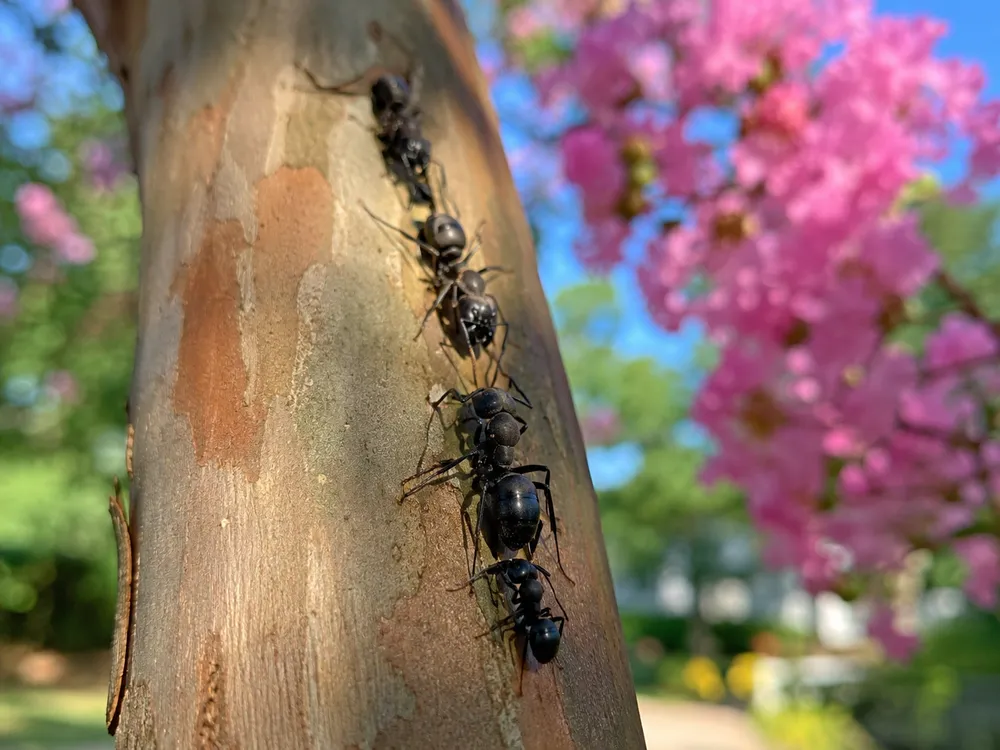
on crape myrtle
Why choose Forterra for carpenter ants
Carpenter ants are not eating your timber. They are hollowing out wood already softened by water, which makes them a symptom of a leak nobody has found. Treat the ants and the damp wood stays ready for the next colony. Forterra traces the moisture first and the nest second, then closes the entry with the Zero Gap System™. Performed under Texas Pest Control License TPCL #850046 and backed by the Forterra money-back guarantee.
3,000+ five-star reviews.
All public. All verifiable.
"Technician was very personable and apparently took care of our Carpenter Ant problems in out guest house. We appreciate the ease of contact with the company and their quick response."
"Parker was awesome. Handled our carpenter ants like a pro. I’d recommend forterra to anybody"
"Cody is very friendly and provides great service. I highly recommend using them."
"Super professional and thorough…."
"Very pleased with Caroline and the job she completed last week."
"Cesar does a great job and keeps us bug free!"
Structural ant work, DFW-wide.
Moisture-damaged wood shows up in every zip code. Carpenter ant exterminators cover all six counties out of Southlake, Dallas and Aubrey.

HQ Southlake
Forterra Pest Control
Pest control service in Southlake, Texas
935 S Kimball Ave Ste. 162
Southlake, TX 76092
2 Dallas
Forterra Pest Control
Pest control service in Dallas, Texas
8300 Douglas Ave Ste. 800 - #802
Dallas, TX 75225
3 Aubrey
Forterra Pest Control
Pest control service in Aubrey, Texas
9053 Ike Byrom Rd Ste 2C
Aubrey, TX 76227
Signs the ants are in the structure.
Carpenter ants excavate wood instead of eating it, and colonies work quietly for months before damage shows. These are the tells that they are already inside.
Piles of coarse frass

Cone-shaped piles of rough sawdust mixed with insect parts appear below kick-out holes near baseboards, window frames and deck joists. DFW's subterranean termites leave no droppings at all, so sawdust piles here mean carpenter ants, their frass looks like pencil shavings.
Rustling inside walls

A mature colony excavating galleries makes a faint, dry rustling you can hear at night with your ear to the wall, loudest near moisture-damaged wood. Tap the wall and an alarmed colony gets briefly louder.
Large ants after dark

Carpenter ants are Texas's biggest ant, up to half an inch, and they forage at night. Big dark ants crossing counters or walls in the evening mean a nest is close, often in a crape myrtle by the house.
Winged swarmers indoors

Flying ants emerging inside the house, with pinched waists and uneven wings, mean a mature parent colony is splitting, and it is mature because it has been in the structure for years.
Spotted any of these? Get your exact price online in about 60 seconds, or call the office and we will take it from there. See my price →
Carpenter ant or termite, the damage bill depends on it.
Both leave damaged wood and both swarm in spring, and homeowners mix them up constantly. The treatments are completely different, so we make this call first, and the inspection that makes it is free.

- Mud tubes running up the foundation
- Hollow wood with soil and mud inside the galleries
- Mud tubes on foundations and walls, and no frass at all. DFW's subterranean termites do not produce it
- Straight antennae, uniform broad waist, pale body
- No mud tubes, they just walk in the open
- Clean galleries, smooth and sanded-looking inside
- Sawdust-like frass (coarser, wood-colored)
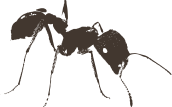
- Bent antennae, pinched waist, dark body
Find the moisture, find the colony.
Carpenter ants live where the moisture is, so carpenter ant treatment starts with the water and ends with the satellite nests, which is how we eliminate them. Killing foragers on the counter changes nothing.
Trace moisture
Wet wood is the map. We follow it.
Carpenter ants favor wood softened by moisture, leaky window headers, deck connections, roof eaves, bath traps. The inspection follows the moisture map, because that is where the galleries are.
Treat network
Parent colony, satellite nests, one connected treatment.
A carpenter ant infestation is a network. A parent colony, often outdoors in a stump or fence, plus satellite nests inside the structure. Targeted non-repellent treatment reaches the galleries and moves colony to colony. Killing foragers alone changes nothing.
Fix conditions
The moisture fixes are the prevention plan, in writing.
You get a written list of the moisture conditions we found, gutter overflows, grade-level wood contact, plumbing weeps, because treated wood that stays wet eventually invites the next colony.
Ready when you are. Real prices online in about 60 seconds, phones answered 24/7.
Moisture-softened wood is the map. Here it is.
Carpenter ants nest where water has already softened the wood. Every numbered point is a moisture story first and an ant story second.
- 01
Eaves and soffits
Overflowing gutters soak the soffit; softened framing here is prime satellite-nest wood.
- 02
Fascia and gutter line
The first wood wet in every storm, and the most common frass point we find.
- 03
Window frames
Failed caulk lets water into sills and headers; rustling here at night is diagnostic.
- 04
Weep holes and brick base
Foraging routes in and out of wall voids follow the brick line's openings.
- 05
Deck connections
The ledger board and rail posts stay damp against the house, classic parent-colony territory.
- 06
Porch posts
Ground-contact posts wick moisture year-round; probing them is part of every inspection.
Forterra's carpenter ant process, step by step.
Structural pests deserve a process with no guesswork in it, and that is how our carpenter ant exterminators work. This one starts with a fixed price and ends with the moisture fix documented.
- 01
Transparent quote
Start with the number. The online tool prices carpenter ant work in about a minute, and the phone team matches it. We scope structural jobs that need gallery work before the first visit, in writing.
- 02
First-visit inspection
Your exterminator examines the structure, attic, deck connections, stumps and fences to confirm carpenter ants rather than termites, and to map both the nests and the moisture feeding them.
- 03
Treat the network
Gallery injections and non-repellent perimeter work that reaches the parent colony and every satellite, not just the ants you see.
- 04
Guaranteed results
We re-treat renewed activity between visits at no cost. We warrant structural work in writing, with the money-back guarantee backing the service itself.
Questions, answered plainly.
If you don't see yours, call (817) 665-6527 or text us, a human will answer.
Check the waist and the wings first. A termite swarmer is straight-waisted, with four matching wings far longer than its body; a carpenter ant is pinch-waisted with elbowed antennae and shorter wings. Debris helps too, coarse shavings-like frass means ants, mud tubes mean termites. Either way, a free termite inspection settles the question.
They damage differently. Termites eat wood; carpenter ants hollow it out for nesting, cutting smooth galleries and tunnels through headers, joists and sills. A colony left alone for years weakens real structure, and because they prefer moisture-softened wood, the damage concentrates exactly where the house can least afford it.
Carpenter ants forage after dark, and the workers you see are a fraction of the colony. A few large ants in the kitchen every evening is consistent with a satellite nest inside the structure and a parent colony within a few hundred feet, often in a nearby tree.
Rarely with success. Sweet baits meant for sugar ants seldom interest carpenter ants long enough, sprays just kill foragers and warn the colony, and nothing on a shelf reaches galleries inside a wall header. Treatment that works targets the nests themselves, parent and satellites both.
Carpenter ant control starts with a written quote. Preventive work rides the quarterly plan while structural jobs carry their own itemized quote. Ongoing service runs $49 monthly with initial visits from $149, and the first visit confirms how many nests exist and where they sit.
Wood shavings and discarded insect parts rather than droppings, which is a useful distinction. Carpenter ants excavate galleries and push the debris out, so the material collecting below is what they have removed. Finding it under a window frame or a deck ledger points at the timber above it rather than anywhere else. Following the shavings upward is quicker than searching a whole wall for a nest.
They do not, which surprises most people. The galleries are living space rather than food, and the ants forage elsewhere for what they actually eat. That is why the damage advances more slowly than termite damage does, and why the water that softened the timber in the first place is the more urgent problem. Fixing the water is what stops it coming back after the nest is gone.
Dealing with a nest while the water goes untraced simply postpones the whole thing. Damp timber stays damp and the next colony arrives to occupy it, usually within a season or two. The sensible order is to trace the moisture first, deal with the nest second and close the way in third, which holds properly. Reversing that order is how the same problem returns the following spring.
Carpenter Ant Control, city by city.
Carpenter ant service by city, from crape myrtle rows to deck-heavy neighborhoods, each with its office.
Start at $49/mo.
Quote in 60 seconds.
No phone call. No credit card up front. See the real price for your home, pick a start date, and a technician will be at your door in about two business days.
- ✓Quarterly Zero Gap treatment
- ✓50+ pests covered
- ✓Free re-treats between visits
- ✓Licensed W-2 technicians, never subcontractors
- ✓Flexible contracts
- ✓Money-back guarantee