

Locally owned · Southlake · Dallas · AubreyView service area →★ 5.0 · 2,900+ reviews
★ 5.0 · 2,900+ Google reviews817-665-6527
★ 5.0 · 2,900+ Google reviews TPCL #850046
SEAL-FIRST · RATS & MICE · See methodology →

Rodent Control in North Texas.

Scratching overhead at night means rats or mice are already inside. Our rodent control seals North Texas homes first, traps what stays behind, then holds the line with secured exterior bait stations checked every quarter.

Free In-person inspection
Exclusion is custom-quoted $500$3,000 typical range
One-story / single entry point at the low end. Multi-story / multiple entries at the high end. The inspection makes the quote real.
Free in-person inspection · Licensed & Insured · TPCL #850046 · Rats & Mice Only
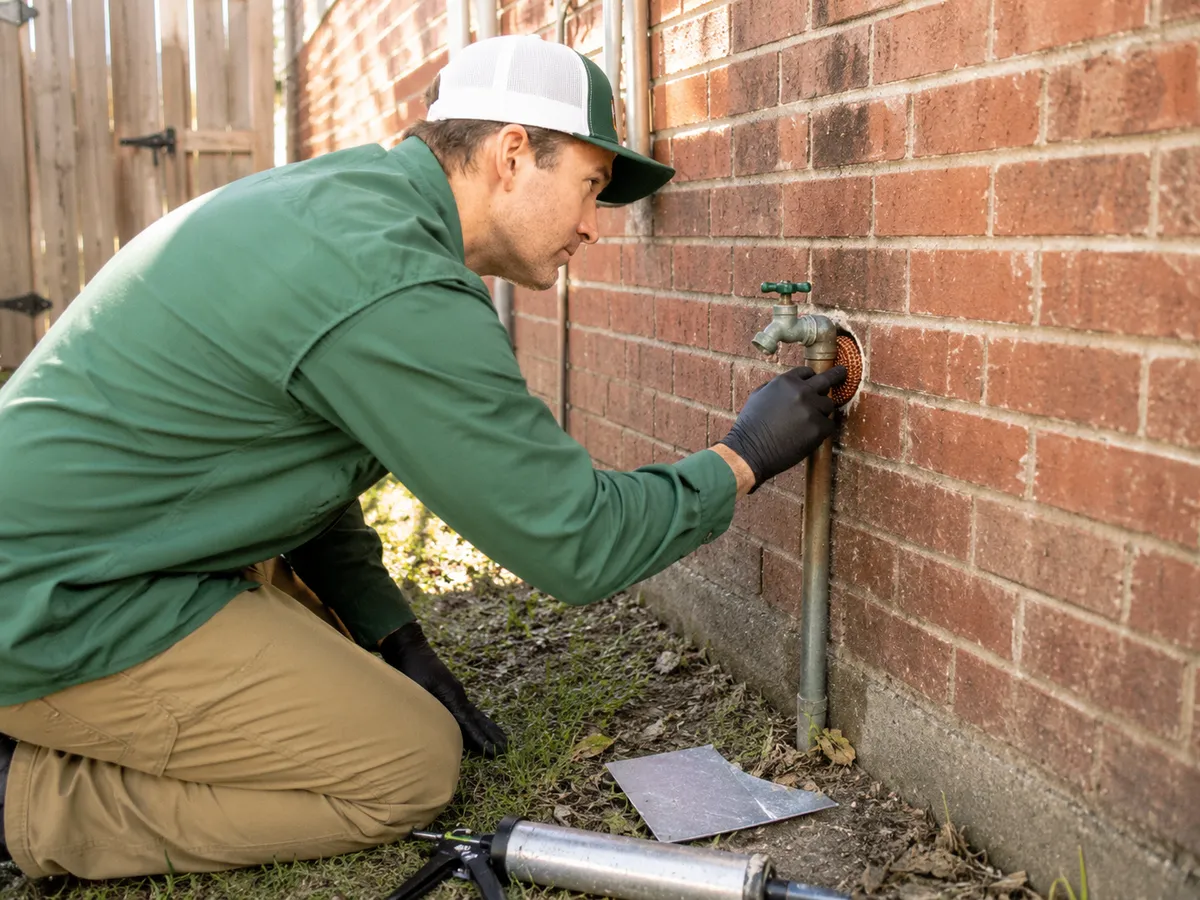
Forterra rodent exclusion hose bib copper mesh
◉ Stage 02 · Exclude
Hose-bib
penetration sealed
Copper mesh + steel flashing
Overview What is Forterra's Rodent Control service?

Forterra Rodent Control is a seal-first rat and mouse service for the Dallas–Fort Worth metroplex: entry points are sealed shut, and whatever is left inside is trapped and removed, we focus on the structural exterior, which is the cause of the problem rather than the symptom. Service is delivered as a three-stage methodology: Inspect (a free in-person inspection identifies every entry point), Exclude (we physically seal entries with copper mesh, galvanized hardware cloth, steel flashing, and masonry sealant, materials matched to each opening), and Monitor (tamper-resistant exterior bait stations catch rodent pressure from neighboring properties before it gets back in). Pricing is custom-quoted by the property and typically falls in the $500 to $3,000 range, single-story homes with one obvious entry sit at the low end; multi-story homes with multiple roof and ground entries sit at the high end. Attic sanitation (cleanup of droppings and nesting debris with antimicrobial treatment) is offered as a separate quoted service; insulation removal and replacement is an insulation contractor's scope, not ours. Performed under Texas Pest Control License TPCL #850046.

Reviews

2,900+ five-star reviews.
All public. All verifiable.

Read all our reviews on Google →
Service area

Rodent routes in six counties.

Sealing crews and trap technicians work from Southlake, Dallas and Aubrey, so an attic in Frisco gets the same exclusion standard as one in Grapevine.

Forterra Pest Control service truck in DFW
ON THE ROAD
You'll spot our trucks across DFW, branded and driven by our own licensed W-2 technicians. All of our trucks have cameras and GPS devices installed because we take careful driving as seriously as we take pests.

HQ Southlake

Forterra Pest Control
935 S Kimball Ave Ste. 162
Southlake, TX 76092

817-665-6527
Serving: Southlake, Grapevine, Colleyville, Keller, Trophy Club, Westlake, Roanoke, Fort Worth, Arlington, Mansfield, North Richland Hills, Watauga, and more
Pest control in Southlake, TX →

2 Dallas

Forterra Pest Control
8300 Douglas Ave Ste. 800 - #802
Dallas, TX 75225

972-349-1621
Serving: Dallas, Highland Park, University Park, Preston Hollow, Lakewood, Richardson, Plano, Sunnyvale, Forney, Addison, and more
Pest control in Dallas, TX →

3 Aubrey

Forterra Pest Control
9053 Ike Byrom Rd Ste 2C
Aubrey, TX 76227

817-670-2835
Serving: Aubrey, Prosper, Frisco, Celina, Little Elm, Providence Village, Cross Roads, Flower Mound, Lewisville, Justin, Highland Village, Denton and more
Pest control in Aubrey, TX →
Are you sure it's rodents?

Six things rats and mice leave behind. If you see any, call us.

Most homeowners spot the symptoms before they see the animal. Rodents are nocturnal and cautious. The droppings, gnaw marks, and grease trails arrive long before you do.

01

Droppings

Rice-grain shaped, dark, often clustered along walls and behind appliances. Fresh droppings are shiny; old droppings are dull and crumbly.

Look here Pantries · garages · attics · under sinks
02

Gnaw marks

Rodent incisors grow continuously, so they chew constantly. Look for tooth marks on baseboards, wood trim, plastic packaging, electrical wiring.

Look here Wires · door corners · food packaging
03

Greasy rub trails

Rats follow the same wall paths every night, leaving dark grease smudges from their fur. A diagonal smudge along a beam is a tell.

Look here Wall studs · ceiling joists · pipes
04

Sounds at night

Scratching, scampering, or thumping in the attic or wall cavity, especially after dusk. Rodents are nocturnal, daytime activity often means a heavy infestation.

Look here Attic above bedroom · wall behind bed
05

Chewed food / nesting

Shredded paper, insulation, or fabric pulled into a soft nest. Stored food with chew marks. Pet food bowls emptied overnight.

Look here Garage · attic insulation · stored boxes
06

An unusual smell

Live rodents have a stale, musky odor. Dead ones have a sweeter, unmistakable smell that lingers for two to three weeks. Both are signs of activity inside the structure.

Look here HVAC returns · enclosed wall cavities

Spotted any of these? Schedule a free in-person inspection. We'll walk the property, find the entry points the rodents are actually using, and quote the exclusion on-site. Schedule the inspection →

Ready when you are. Real prices online in about 60 seconds, phones answered 24/7.

The Forterra rodent methodology

Most companies trap and bill. We seal the building.

Rodent control is a structural problem dressed up as a pest problem. Trapping the rats inside without sealing the building is a treadmill, kill ten this month, ten more come in next month. We work the other way: find the entries, seal them durably, then monitor for new pressure outside.

Stage 01
01

Inspect

We find every entry point, the obvious ones and the ones you'd never spot.

A trained inspector walks the structural exterior of your home: ground level, roof line, eaves, vents, utility penetrations. Rodents only need a hole the size of a quarter (rats) or a dime (mice). Our job is to find every one of them. The inspection is in-person, on-site, and free. The quote that comes out of it is a real plan with real materials and a real timeline, not an estimate.

  • Foundation walk, every weep hole, vent, and crack
  • Roof line check, soffits, gables, dormer junctions, ridge
  • Utility penetrations, HVAC, plumbing, electrical, dryer vent
Stage 02
02

Exclude

We seal each entry point with materials rats and mice can't chew through.

This is the work. Foam alone is not exclusion, rodents chew through expanding foam in days and we know technicians who only spray foam. Real exclusion uses copper mesh stuffed deep into the gap, hardware cloth or steel flashing fastened over the opening, and masonry sealant or concrete patch where the structure allows. The inspection determines the materials; the materials determine the durability.

  • Copper mesh, packed deep, won't rust or be chewed
  • Galvanized hardware cloth + steel flashing for openings
  • Masonry / concrete patch on foundation cracks
Stage 03
03

Monitor

Tamper-resistant exterior bait stations catch incoming pressure before it gets back in.

Once entries are sealed, the work shifts from emergency to maintenance. We install lockable, tamper-resistant exterior bait stations at high-pressure points along the foundation. They intercept rodent pressure from neighboring properties and surrounding habitat, the population that wants in next. Stations are inspected and serviced quarterly. This is what makes exclusion durable.

  • Tamper-resistant, locked exterior stations
  • Quarterly service, bait check, refill, observation log
  • Catches new pressure before it finds a new gap
Photo: David Dance, Forterra
Why exclusion matters, David Dance, Forterra

"You can pay somebody to trap rats in your attic every quarter forever, or you can pay once to seal the building and stop the problem at the source. Trapping is somebody else's recurring revenue. Exclusion is the actual fix. We do exclusion because it's the part that holds, the rats either find a way in or they don't, and our work is what decides that."

David Dance Owner · Commercial Certified Applicator · TPCL #850046
Where rodents actually get in

Nine entry points on the average DFW home. The inspection finds yours.

Roof rats enter from above. Norway rats enter from below. Most homes have a mix. The diagram below is what we look for during the free in-person inspection, the same nine vectors on every house, with details that vary by construction.

1 2 3 4 5 6 7 8 9 Cross-section, two-story DFW home. Numbers reference the entry-point list at right.
Inspected entry point
▲ Above grade Roof rats, climbers
▼ Below grade Norway rats, burrowers
  1. 01

    Roof / ridge vents

    Roof rats enter through metal ridge vents with worn flashing. Sealed with steel hardware cloth from underneath.

  2. 02

    Gable & attic vents

    Triangular gable vents with chewed-through screening. Re-screened with 1/4″ galvanized hardware cloth.

  3. 03

    Soffit / fascia gaps

    Where the roof meets the wall, framing gaps open up over time. Mice need only a dime-sized opening.

  4. 04

    Roofline / dormer junctions

    Where dormers, valleys, and chimney flashings meet the main roof. High-traffic for climbing rats.

  5. 05

    HVAC penetrations

    Refrigerant lines and condensate drains pass through the wall, sealed with copper mesh and silicone.

  6. 06

    Dryer vent

    Plastic dryer vents are chewed through routinely. Replaced or armored with steel sleeve.

  7. 07

    Garage door bottom

    Worn weatherstrip on garage doors leaves a gap rats walk under. Replaced with rodent-resistant seal.

  8. 08

    Foundation cracks / weep holes

    Brick weep holes are entry-by-design. Open weeps get screened; foundation cracks get patched.

  9. 09

    Sewer / utility penetrations

    Where plumbing or electrical conduit enters the foundation. Often the largest single gap on the home.

Quarter Smallest gap a rat needs (≈ 1/2″)
Dime Smallest gap a mouse needs (≈ 1/4″)
9 entry points Inspected on every home, regardless of report
1 day Most exclusion jobs finish in a day
What we treat

Rats and mice. Nothing else, on this service.

Forterra rodent control covers commensal rats and house mice, the species that actually share buildings with people in DFW. Squirrels, raccoons, possums, and other wildlife are a different trade with different tools and skills, and we'll happily refer you to a wildlife specialist.

Rats

Roof rats & Norway rats

Body 7–10″ · Tail length matches body
Behavior
Roof rats are climbers, they enter through the roof. Norway rats are burrowers, they enter through the foundation. Both leave thumb-sized droppings and grease trails.
What makes them tricky
Smart, neophobic (fear new objects), and can squeeze through any gap a quarter fits through. They learn trap locations. Real exclusion is the only durable answer.
How we approach them
  • Roof-line inspection priority for climbers
  • Foundation + utility penetrations for burrowers
  • Bait stations sized for rat-scale entry

Mice

House mice

Body 2.5–4″ · Tail length matches body
Behavior
Smaller, faster, and able to fit through openings as small as 1/4 of an inch. House mice produce 6–10 droppings a day, more visible evidence than rats.
What makes them tricky
Reproduce rapidly, one female can produce 8 litters a year. A small mouse problem becomes a big mouse problem in weeks, not months.
How we approach them
  • Tighter mesh (1/4″ hardware cloth)
  • Soffit and roof junction detailing
  • Smaller-aperture exterior bait stations
How a Forterra rodent project runs

Six steps from "I think we have rats" to a building that stops them.

The first step is the only one with a fee at risk, and it's free. Everything below it is optional, you'll have a written quote in 24 hours and decide from there.

  1. 01

    Schedule the free in-person inspection

    Book online or by phone. We confirm a 2-hour arrival window. The inspection is in-person, on-site, and free, there is no per-visit fee, no diagnostic charge, no obligation.

    Free · ~60 minutes
  2. 02

    Walkthrough & entry-point map

    An inspector walks every face of your home, foundation, eaves, roof, utility penetrations. We document each entry point with photos and mark severity. You see what we see, in real time.

    On-site · findings documented
  3. 03

    Custom quote & scope

    Within 24 hours you have a written quote: every entry point, every material, every line item. Not a verbal estimate, a real plan. You can compare it to anyone you'd like.

    Quote within 24 hours
  4. 04

    Exclusion day, seal each entry

    Most homes are sealed in a single day. We work the roof line first, then mid-house, then ground. Every gap gets the right material, copper mesh, hardware cloth, steel flashing, masonry sealant.

    Most homes: 1 day
  5. 05

    Optional · Attic sanitation

    Optional

    If droppings or contaminated insulation are present, we can quote droppings and nesting cleanup with antimicrobial treatment (insulation removal and replacement is an insulation contractor's job, not ours), and replacement insulation as a separate scope. Pricing varies by attic size and contamination level.

    Optional · separately quoted
  6. 06

    Monitoring, quarterly station service

    Tamper-resistant bait stations are installed at high-pressure points along the foundation. We service them quarterly: bait check, refill, photo log. This catches new pressure from neighboring properties before it can find a new gap.

    Quarterly · ongoing
Pricing, what to expect

Custom-quoted, but the range is honest. $500 to $3,000.

The free in-person inspection is what makes the quote real. We don't price exclusion blind. Below is the range and what moves a quote from one end to the other.

$500
~$1,200 typical mid-range
$3,000
Smaller scope Larger scope
Low end · ~$500

One-story · single obvious entry

A small ranch home with one identifiable entry point, a worn dryer vent, a broken weep-hole screen, a clear gap at the garage door bottom. Half-day exclusion, one visit.

  • 1 entry point, ground-level
  • ~½ day on-site
  • Includes 2 monitoring stations
High end · ~$3,000

Multi-story · multiple roof & ground entries

A two-story home with mixed pressure: roof rats entering at gable vents and soffit gaps, plus Norway-rat activity at the foundation. Full-day exclusion, often two technicians and a ladder.

  • 5+ entry points across roof and ground
  • 1–2 days on-site, 2 technicians
  • Includes 4–6 monitoring stations
What moves the price
Number of entry points Each entry takes time and material. The single biggest factor.
Roof-line work Ladder work, fall protection, and detailing on dormers / valleys add scope.
Material per opening A weep hole takes minutes; a hose-bib penetration through brick takes longer.
Monitoring station count Larger lots and corner properties need more stations along the foundation.
Construction type Brick veneer, stucco, and stone all detail differently. Stucco repairs add cost.
Quoted separately

Attic sanitation

If droppings or contaminated insulation are present, attic sanitation is a separate quoted scope: droppings and nesting cleanup with antimicrobial treatment, insulation removal and replacement not included. Cost varies by attic size and contamination level, we always quote it on-site.

Optional · on-site quote
Frequently asked

Rodent-control questions, answered plainly.

If you don't see yours, call (817) 665-6527 or text us, a human will answer.

Yes, in the order that works. Entry points are sealed first, then whatever is left inside gets trapped and removed, about a week for most homes. Interior work is part of the job, not a referral. Sealing the outside without trapping the inside leaves rodents stuck inside; trapping the inside without sealing the outside is a treadmill. The two services pair.

Custom-quoted by the property, typically $500 to $3,000. A small one-story house with one obvious entry point sits at the low end. A multi-story home with multiple roof and ground entry points sits at the high end. The free in-person inspection is what makes the quote real; we don't price exclusion blind.

We physically seal entry points with materials rats and mice cannot chew through, copper mesh, galvanized hardware cloth, steel flashing, and concrete or masonry sealant where appropriate. Foam alone is not exclusion, they chew through expanding foam in days. Our work is durable and backed against re-entry through the points we sealed.

In the attic, yes, absolutely. The building gets sealed first, then everything sealed inside gets trapped out, and the attic is one of the most common places we set traps. Inside walls, no. Traps go where a technician can reach and check them. If your visitor is a squirrel or raccoon rather than a rat or mouse, that's wildlife work, and we'll point you to a good operator.

Because it can be expensive, and not everyone wants or needs it. We typically recommend attic sanitation for medium to heavy infestations, meaning cleanup of droppings and nesting debris with antimicrobial treatment, quoted separately by attic size and contamination level. Insulation removal and replacement is insulation-contractor work, not something we perform, and we say so plainly.

After exclusion, we install tamper-resistant exterior bait stations along the foundation and at high-pressure points. They catch rodent pressure from neighboring properties before it tries to find a new way in. Stations are serviced quarterly. This is the Monitor stage of our methodology and is included in the exclusion quote unless you opt out.

Most jobs finish in one day. A small home with two or three entry points may take a half day; a larger home with attic-level work and multiple ground entries may take a full day or two. The inspection establishes the scope, and your quote tells you the exact timeline.

Yes. Roof rats are excellent climbers and enter through attic and roof-level penetrations, vents, gable openings, soffit gaps. Norway rats are ground-level burrowers and enter through foundation cracks, garage doors, weep holes, and utility penetrations. Most DFW homes have one or the other depending on neighborhood, but our approach inspects both vectors regardless.

No. Forterra rodent control covers rats and mice only. Squirrels, raccoons, possums, and other wildlife are a separate trade with different tools and skills. We're glad to refer to a wildlife specialist.

If a rodent re-enters through a point we sealed, we come back and re-do that exclusion at no charge. If a new entry point opens up, say a contractor cuts a new penetration in your roof, that's new scope, but we'll inspect it free.

Near you

Rodent Control, city by city.

Pick your city for rodent specifics, which office covers you, and how the seal-first program lands there.

Ready when you are

Free in-person
inspection.

No phone tree, no diagnostic fee, no pressure. We'll walk your property, find every entry point the rodents are actually using, and you'll have a written quote in 24 hours. From there, you decide.

Inspect · Exclude · MonitorThree-stage methodology
Seal-firstRats & mice, sealed then trapped
5.0 ★ · 2,900+ reviewsGoogle verified
TX TPCL #850046Licensed & Insured
In-person inspection Free
Inspection finds the entry points; exclusion quoted from it, typically $500 – $3,000
  • On-site walkthrough & entry-point map
  • Written quote within 24 hours
  • Copper mesh, hardware cloth, steel flashing
  • Tamper-resistant monitoring stations
  • Re-entry through sealed points: free re-do
  • No obligation from the inspection
Schedule my inspection →
Inspection & quote are free. You only pay if you approve the exclusion scope.
Call Get my free quote · 60 sec Get my (free) online quote