Rodent Control in Aubrey, TX
Attic sanitation, from droppings cleanup to antimicrobial treatment, is a separate quote we recommend for medium and heavy infestations. Our rodent control in Aubrey covers the core job, sealing the entry points first and then trapping what remains inside.
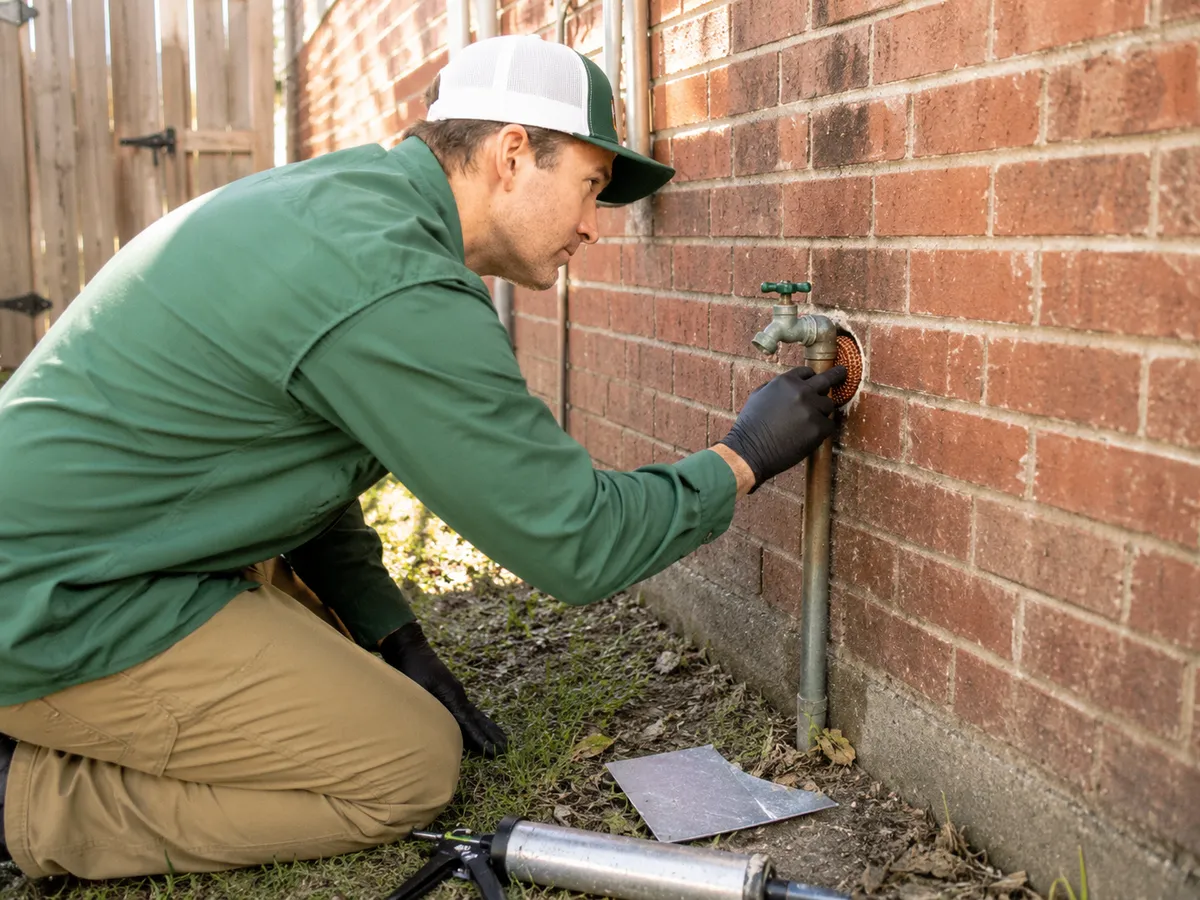
penetration sealed
Why choose Forterra for rodents in Aubrey
New Aubrey subdivisions sit on what was pasture a season or two ago, and the mice and rats that lived there move into the nearest house with the first cold spell. Barns, workshops and feed storage double the risk on acreage. Forterra closes the builder gaps around pipes, garage returns and roof joins with the Zero Gap System™, ideally before October, and says which outbuildings belong in the plan. Licensed TPCL #850046, free inspection for interior rodent issues.
Forterra Aubrey.
Rodent work from the Aubrey office on new Aubrey homes centers on the gaps builders leave around pipework, which we close before any trap goes down.
Aubrey, TX 76227
- Rating
- ★ 5.0 · 343 reviews
- Service
- Mon to Fri, 7:00am to 7:00pm
- Phones
- Phones answered 24/7
- License
- TPCL #850046
Why Rodents Thrive in Aubrey
The Aubrey office deals with a different animal profile than the metro offices do. Out here the pressure comes off open ground, so house mice and field mice moving in ahead of cold weather are the most common call, along with Norway rats around anything storing feed. Properties with barns, workshops or covered storage are running two buildings' worth of risk, and treating only the house leaves the source alone.
New construction is the local complication. A house finished last year can still have unscreened weep holes, an unsealed garage door corner and gaps behind fresh brick, and the surrounding pasture puts rodents against that wall every night. We seal first, trap second, and we are direct about which outbuildings are worth including. Interior inspections are free because the price depends on how the structure is failing, not on the count.
Seasonality is sharper out here than in the metro. The first genuinely cold nights move field populations toward buildings within days, and a property that was clear in October can have an active problem by November. Sealing before that happens is far cheaper than trapping afterwards, which is why we push the timing rather than waiting for the call.
343+ five-star reviews.
Serving Aubrey.
"Very thorough & friendly service."
"Billy Always does a great job. Please let him continue to be the one that comes to my home"
"Casey did amazing. He notified me when he was going to arrive and then did the mosquito service in a timely manner."
"Highly recommend! Great service!"
Ready when you are. Real prices online in about 60 seconds, phones answered 24/7.
Most companies trap and bill. We seal the building.
Rodent control is a structural problem dressed up as a pest problem. Trapping the rats inside without sealing the building is a treadmill, kill ten this month, ten more come in next month. We work the other way: find the entries, seal them durably, then monitor for new pressure outside.
Inspect
We find every entry point, the obvious ones and the ones you'd never spot.
A trained inspector walks the structural exterior of your home: ground level, roof line, eaves, vents, utility penetrations. Rodents only need a hole the size of a quarter (rats) or a dime (mice). Our job is to find every one of them. The inspection is in-person, on-site, and free. The quote that comes out of it is a real plan with real materials and a real timeline, not an estimate.
- Foundation walk, every weep hole, vent, and crack
- Roof line check, soffits, gables, dormer junctions, ridge
- Utility penetrations, HVAC, plumbing, electrical, dryer vent
Exclude
We seal each entry point with materials rats and mice can't chew through.
This is the work. Every entry point gets the material that suits its size, position and surface, fastened so rodents cannot chew or push their way back through. The inspection decides the materials, and the materials decide how long the repair lasts.
- Material matched to each opening
- Roofline gaps first, then ground level
- Foundation cracks patched where the structure allows
Monitor
Tamper-resistant exterior bait stations catch incoming pressure before it gets back in.
Once entries are sealed, the work shifts from emergency to maintenance. We install lockable, tamper-resistant exterior bait stations at high-pressure points along the foundation. They intercept rodent pressure from neighboring properties and surrounding habitat, the population that wants in next. Stations are inspected and serviced quarterly. This is what makes exclusion durable.
- Tamper-resistant, locked exterior stations
- Quarterly service, bait check, refill, observation log
- Catches new pressure before it finds a new gap
"You can pay somebody to trap rats in your attic every quarter forever, or you can pay once to seal the building and stop the problem at the source. Trapping is somebody else's recurring revenue. Exclusion is the actual fix. We do exclusion because it's the part that holds, the rats either find a way in or they don't, and our work is what decides that."
Nine entry points on the average DFW home. The inspection finds yours.
Roof rats enter from above. Norway rats enter from below. Most homes have a mix. The diagram below is what we look for during the free in-person inspection, the same nine vectors on every house, with details that vary by construction.
- 01
Roof / ridge vents
Roof rats enter through metal ridge vents with worn flashing, and we seal them from underneath.
- 02
Gable & attic vents
Triangular gable vents with chewed-through screening, re-screened at a gauge rodents cannot pass.
- 03
Soffit / fascia gaps
Where the roof meets the wall, framing gaps open up over time. Mice need only a dime-sized opening.
- 04
Roofline / dormer junctions
Where dormers, valleys, and chimney flashings meet the main roof. High-traffic for climbing rats.
- 05
HVAC penetrations
Refrigerant lines and condensate drains pass through the wall, and we close the gap around each one.
- 06
Dryer vent
Rodents chew through plastic dryer vents routinely, so we replace or reinforce them.
- 07
Garage door bottom
Worn weatherstrip on garage doors leaves a gap rats walk under, and we fit a rodent-resistant seal.
- 08
Foundation cracks / weep holes
Brick weep holes let mice in by design, so we screen open weeps and patch foundation cracks.
- 09
Sewer / utility penetrations
Where plumbing or electrical conduit enters the foundation. Often the largest single gap on the home.
Six steps from "I think we have rats" to a building that stops them.
The first step is the only one with a fee at risk, and it's free. Everything below it is optional, you'll have a written quote in 24 hours and decide from there.
- 01
Schedule the free in-person inspection
Book online or by phone. We confirm a 2-hour arrival window. The inspection is in-person, on-site, and free, there is no per-visit fee, no diagnostic charge, no obligation.
- 02
Walkthrough & entry-point map
An inspector walks every face of your home, foundation, eaves, roof, utility penetrations. We document each entry point with photos and mark severity. You see what we see, in real time.
- 03
Custom quote & scope
Within 24 hours you have a written quote listing every entry point and every line item. Not a verbal estimate, a real plan you can compare with anyone you like.
- 04
Exclusion day, seal each entry
We seal most homes in a single day, working the roof line first, then mid-house, then ground, with the right material for every gap.
- 05
Optional · Attic sanitation
OptionalIf droppings or contaminated insulation are present, we can quote droppings and nesting cleanup with antimicrobial treatment (insulation removal and replacement is an insulation contractor's job, not ours), and replacement insulation as a separate scope. Pricing varies by attic size and contamination level.
- 06
Monitoring, quarterly station service
Tamper-resistant bait stations are installed at high-pressure points along the foundation. We service them quarterly: bait check, refill, photo log. This catches new pressure from neighboring properties before it can find a new gap.
Custom-quoted, but the range is honest. $500 to $3,000.
The free in-person inspection is what makes the quote real. We don't price exclusion blind. Below is the range and what moves a quote from one end to the other.
Attic sanitation
If droppings or contaminated insulation are present, attic sanitation is a separate quoted scope: droppings and nesting cleanup with antimicrobial treatment, insulation removal and replacement not included. Cost varies by attic size and contamination level, we always quote it on-site.
Aubrey Rodent Control FAQ
If you don't see yours, call (817) 670-2835 or text us, a human will answer.
Because the ground your street sits on was pasture very recently, and clearing it removed the cover rather than the animals. They relocate to the nearest standing structure, which is your house. The first cold spell after construction is when most owners notice. Nothing about the house is dirty or neglected. It is simply the only shelter left on that piece of land.
Through what the builder left open rather than through anything broken. The hole cut for a pipe or a cable is nearly always bigger than the pipe, and no inspection treats that as a fault. Garage returns and the join beneath a roofline account for most of the rest. In Aubrey those few openings are the entire story of it.
Only for a few weeks. Removing what is inside while the way in stays open means the next one finds the same route, which is why households end up trapping forever and calling it maintenance. The order matters here. Close the entry points first, then trap whatever is already living inside your Aubrey home, attic included.
Either, and the droppings tell you faster than the noise does. Something the size of a rice grain points to mice, while something closer to an olive pit points to rats. Rats also tend to be heavier overhead and more deliberate. Around Aubrey both turn up, and the plan stays the same for either, sealing first and then trapping where the activity shows.
Not for an interior rodent problem. That assessment is free, which is deliberately different from how we quote the rest of the work, because nobody should have to pay just to learn whether something is living in the walls. An exterminator confirms what it is, finds how it got in, and you decide about treatment with the facts in front of you.
It depends on the gap. Your exterminator picks the material by size and position, since what suits a pipe opening rarely suits a garage return, and every repair has to hold against chewing. On an Aubrey build the openings are regular, so the closure should last for years with nobody needing to come back to it.
Usually within a couple of weeks of the entry work, though it can sound worse for a few days first as trapped animals move about looking for a route that no longer exists. That is a sign the sealing worked rather than a problem. If activity continues beyond that, say so and somebody returns, because it points to a second opening we missed.
No. We trap in the attic and other open spaces, but never inside a wall, because nobody can reach a caught animal there without opening the finished surface. Sealing first pushes what is inside toward the traps. Droppings and nesting material cleanup is a separate sanitation quote, recommended when an Aubrey attic shows a medium to heavy buildup.
Rodent Control near Aubrey.
Same treatment and the same guarantee from the same offices. See the DFW rodent control overview →
Free in-person
inspection.
No phone tree, no diagnostic fee, no pressure. We'll walk your property, find every entry point the rodents are actually using, and you'll have a written quote in 24 hours. From there, you decide.
- ✓On-site walkthrough & entry-point map
- ✓Written quote within 24 hours
- ✓Materials matched to each opening
- ✓Tamper-resistant monitoring stations
- ✓Free re-do if rodents get back in through a sealed point
- ✓No obligation from the inspection