
"Excellent customer service. Friendly and thorough."
Moth Control in DFW
Clothes and pantry moths are separate jobs, and the wrong one wastes a visit. Moth control for DFW homes settles which of them you have before opening a cupboard. Treatment and sealing then follow together.
up close
Two completely different jobs travel under one name. Moths in your wardrobe are working on natural fibers, with larvae doing the damage out of sight in folds and under collars. Moths in your kitchen came in inside something already infested. Forterra establishes which kind you have before opening a cupboard, then seals what needs sealing with the Zero Gap System™. Texas Pest Control License TPCL #850046, money-back guarantee.
2,900+ five-star reviews.
All public. All verifiable.
"Gabrael did a wonderful job on my Pest Control this morning. He was very thorough and did things I wasn't even expecting and performed a detailed Pest Control inside and outside my home. I was very impressed with his overall service and polite and kind demeanor. Excellent service!"
"Frontera always does a fantastic service! My service technician, Parker, always does an great job and is a terrific communicator!!"
"Caroline did a fantastic job, walked us through each step and made sure we were happy with our service."
"I have used Forterra past couple of years and the service has been excellent"
"Gabrael of Forterra Pest Control did a great job at our house. I highly recommend Forterra and Gabrael! George"
Moth protocols, three offices deep.
Pantry clear-outs and closet traces run from Southlake, Dallas and Aubrey on normal service routes, with monitors checked as visits come due.
HQ Southlake
Forterra Pest Control
935 S Kimball Ave Ste. 162
Southlake, TX 76092
2 Dallas
Forterra Pest Control
8300 Douglas Ave Ste. 800 - #802
Dallas, TX 75225
3 Aubrey
Forterra Pest Control
9053 Ike Byrom Rd Ste 2C
Aubrey, TX 76227
Where you saw the moth tells us what it's eating.
The moth in the closet and the moth in the kitchen are different species with different diets. In both cases the adults are harmless; the larvae do all the damage.
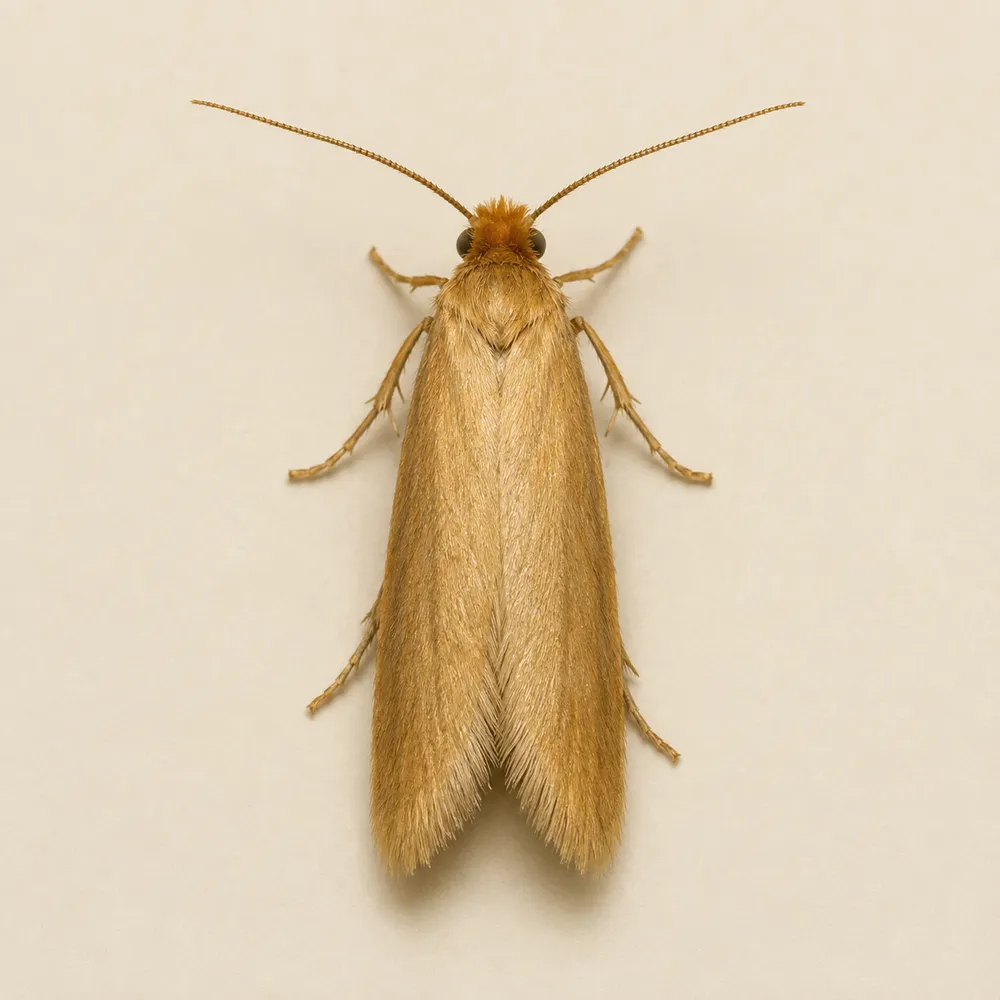
CLOSETS Webbing clothes moth
- Behavior
- A small golden moth that hides in dark closets and flutters rather than flying to light. Larvae eat wool, silk, cashmere, felt and fur, working garment seams and rug edges.
- What makes them tricky
- Holes in a sweater mean generations have cycled. Dry cleaning treats the garment; the population lives in the closet itself, which is what gets treated.
- How we approach them
-
- Wardrobe checked seam by seam
- Closet edges and carpet lines treated
- Garments cleaned, then stored sealed
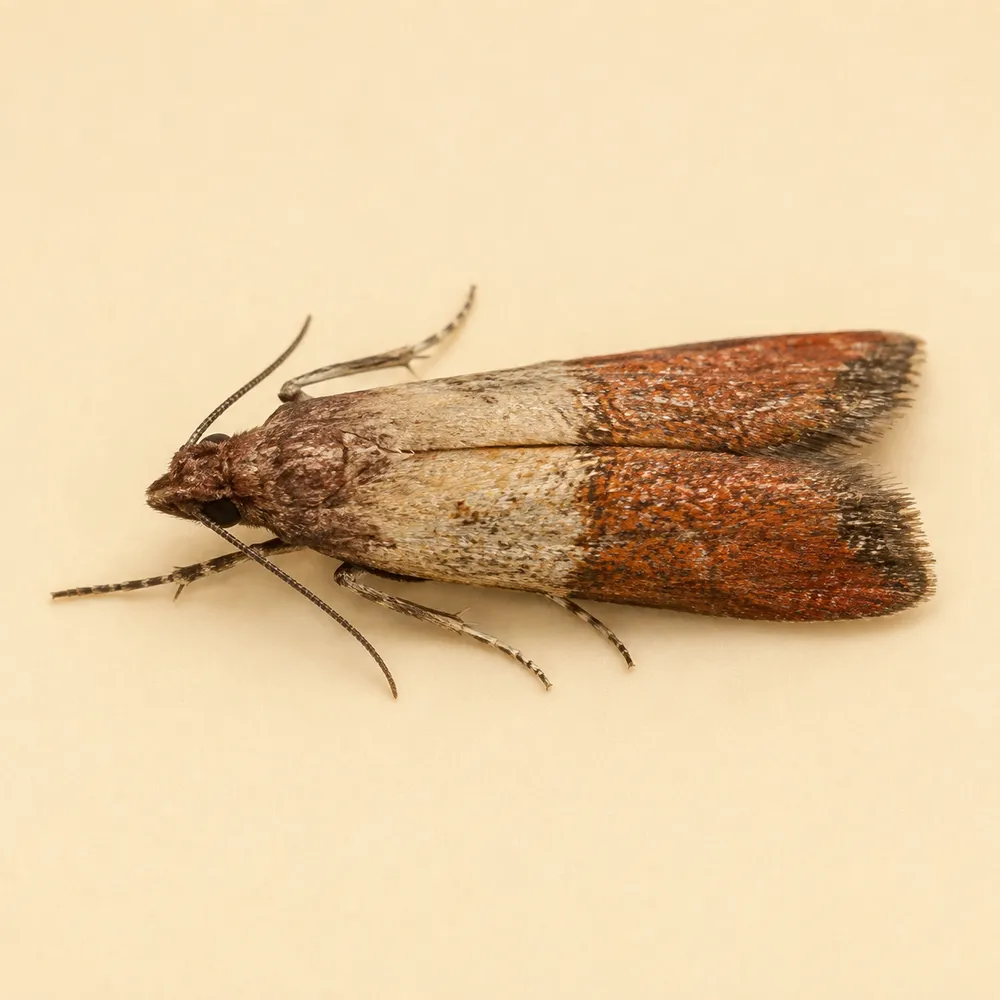
PANTRY Indianmeal moth
- Behavior
- The pantry moth, coppery outer wings, gray inner, zigzagging through kitchens at dusk. Larvae infest cereals, grains, flour, nuts, dried fruit and pet food, webbing the product into clumps.
- What makes them tricky
- It arrives inside a purchased package and spreads pantry-wide. Larvae wander to pupate in hinge corners and ceiling joints, so trashing the cereal alone never ends it.
- How we approach them
-
- Pantry traced package by package
- Pupation crevices vacuumed and treated
- Pheromone monitors confirm the break
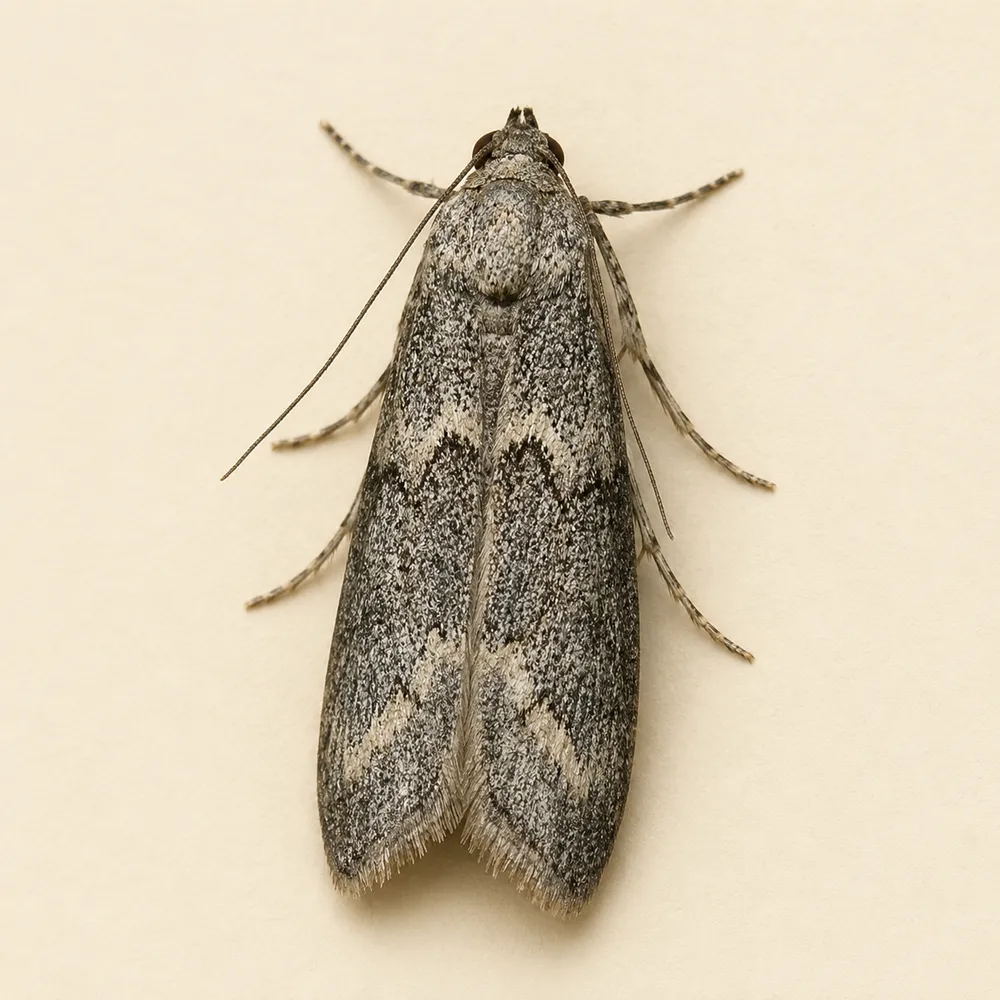
PANTRY Mediterranean flour moth
- Behavior
- The other DFW pantry moth, gray with dark zigzag bands, favoring flour and meal. Larvae web flour into the clumps and mats that clog package corners and cabinets.
- What makes them tricky
- Treatment matches the Indianmeal moth, which is the point. Pantry moths are a source-tracing job, not a spraying job. Webbed, clumped flour confirms it either way.
- How we approach them
-
- Same trace-and-clear protocol as Indianmeal
- Flour storage moved to hard containers
- Monitors placed for the following weeks
Find the infested item, and the moths are finished.
Moth control is a hunt for the source item, an infested package or garment, because the flying adults are just the evidence. Find it and the cycle ends.
Identify moth
Closet moth or pantry moth decides the entire hunt.
Closet moths and pantry moths never share a source. The species tells us which hunt we are on, through the wardrobe and rugs, or package by package through the kitchen.
Remove sources
Every source found and out of the house, cleaned or discarded.
In the pantry, every open grain product gets inspected, infested ones discarded, survivors quarantined in glass or hard plastic. In the closet, infested garments get cleaned or discarded, rugs checked along their hidden edges. Miss one source and the cycle restarts; this step is the treatment.
Treat crevices
Crevice treatment plus monitors that prove the cycle broke.
Crack-and-crevice treatment where the larvae pupate, cabinet corners and hinges in kitchens, closet edges and carpet lines in wardrobes, never on food or clothing surfaces. Pheromone monitors confirm the population is actually gone.
Ready when you are. Real prices online in about 60 seconds, phones answered 24/7.
Closet moth or pantry moth, two hunts, one map.
The two moth problems live at opposite ends of the house. This is where each hunt happens, and why identifying your moth first saves treating the wrong rooms.
- 01
Pantry shelves
Indianmeal moths, webbing in flour, cereal and pet food. The kitchen side of the hunt.
- 02
Cabinet crevices
Pantry moth larvae pupate in hinge corners and shelf joints, surviving shelf wipes.
- 03
Closet and stored clothes
Clothes moths work wool and silk in the dark. The bedroom side of the hunt.
- 04
Under-furniture rug edges
The hidden rug strip beneath the bed is the classic clothes-moth feeding site.
- 05
Baseboard lines
Larvae travel the wall lines; crevice treatment cuts the route between rooms.
- 06
Attic storage
Boxed fabrics and holiday textiles get checked; sealed bins are the permanent fix.
Forterra's moth process, step by step.
Whether the trail starts in the pantry or the closet, the process is the same four steps, and the price arrives before the technician does.
- 01
Transparent quote
Quote first, always. It takes about sixty seconds online or a phone call, sized to the home. Pantry or closet, the moth-service price is in writing before any visit is booked.
- 02
First-visit inspection
Species comes first, then the trace, pantry shelves package by package, or closets seam by seam, including the rug edges hiding under furniture.
- 03
Clear, treat, monitor
Sources removed, harborage treated, storage corrected, and pheromone monitors placed so the next weeks prove the cycle is broken rather than assume it.
- 04
Guaranteed results
Activity on the monitors after the clear-out earns a free follow-up visit. The money-back guarantee stays in force for as long as the plan does.
Questions, answered plainly.
If you don't see yours, call (817) 665-6527 or text us, a human will answer.
That flight pattern plus the location says Indianmeal moths, DFW's standard pantry moth. Somewhere in the kitchen a package of grain, cereal, nuts or pet food is infested and producing them. Look for silk webbing that clumps the product; the flying adults are just the proof that the nursery exists.
Two reasons. Eggs ride in packages you would not suspect, spices, dried fruit, birdseed, decorative corn, and mature larvae leave the food entirely to pupate in cabinet-hinge corners and ceiling joints. A clean-out that misses one package or skips the crevices restarts in a month. Our version is package by package, then the cracks.
Sometimes they are carpet beetles instead, which changes the hunt, so we identify before treating. If it is clothes moths, larvae did the eating, they prefer wool, silk and fur, and they work stored garments and hidden rug edges. Cleaning the garments helps, but the closet population is what has to be treated.
Mostly no. Cedar's oils fade within a year or two and old cedar chests are just nice boxes; mothballs need an airtight space to reach effective concentrations and make the closet toxic-smelling long before then. What works is cleaned garments in sealed storage plus treatment of the closet itself, which is the boring, effective answer.
Moth service, pantry or closet, comes inside quarterly coverage at $49 monthly, trace-and-treat visit and monitors included. Heavy clothes moth infestations get their own advance price; cleaning of the garments stays with the household.
It does, provided the temperature and the duration are right. A domestic freezer over several days will kill eggs and larvae in a garment that cannot be washed hot, which makes it a genuinely useful option for wool and cashmere. Sealing the item in a bag first prevents condensation damaging it on the way out. Seventy two hours at a proper freezing temperature is the usual guidance.
Because the oil that repels them fades within months and never killed anything to begin with. Fresh cedar has some deterrent effect on newly hatched larvae and none whatsoever on an established population, so a chest lined decades ago is doing nothing at all. It is a pleasant smell rather than a control method. Cedar deters nothing that is already living in the wool.
They are not, which is why the damage is so often discovered late. Adult moths do not feed at all, and everything that matters is done by larvae working inside stored material where nobody is looking. By the time something is flying in a room, the holes in whatever it came from already exist. The flying stage is the evidence rather than the cause.
Moth Control, city by city.
Moth help mapped city by city, covering office included on every page.
Start at $49/mo.
Quote in 60 seconds.
No phone call. No credit card up front. See the real price for your home, pick a start date, and a technician will be at your door in about two business days.
- ✓Quarterly Zero Gap treatment
- ✓50+ pests covered
- ✓Free re-treats between visits
- ✓Licensed W-2 technicians, never subcontractors
- ✓Flexible contracts
- ✓Money-back guarantee