

Residential Pest Control
Starting from
$49 /mo
Ants, roaches, spiders, scorpions, crickets, wasps, fleas, ticks. Quarterly Zero Gap treatment™, the foundation of Forterra's treatment plan.
Learn more about residential pest control →Get your price online, pick any month to start, and the first visit seals the gaps pests use before regular treatment begins. Free returns between visits are part of pest control in Pilot Point from then on.
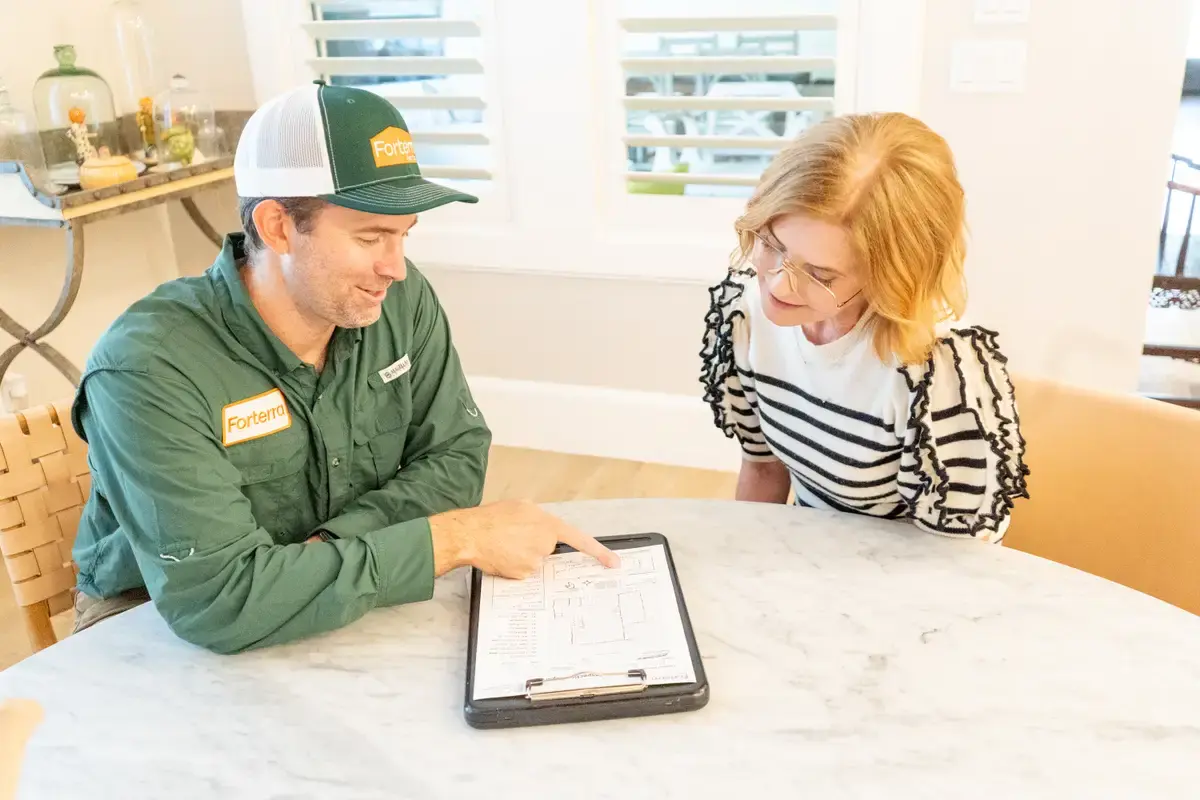
Barns, outbuildings and older homes near the square give a Pilot Point property more structures than a suburb has, and anything unheated is a staging point for what eventually enters your house. Forterra counts every structure before starting. Forterra seals each one with the Zero Gap System™, under Texas Pest Control License TPCL #850046, backed by the Forterra money-back guarantee.
"Great service! They have solved my pest issues!! Super happy!"
"Work completed efficiently, let me know when he was performing services, even though I was not home."
"Very professional!! Ryan did a great job"
"casey did a great job. he assisted my wife and gave her advice regarding treatment of roaches. I appreciate the extra effort he gave. Great job Casey"
76258 takes in Pilot Point whole, square-side blocks and horse properties down every county road. A gate, a barn dog or a preferred approach gets noted through (817) 670-2835 once and remembered permanently, and each property prices from its measurements, with horse-country geography adding flies and character but not one line to the figure. North edge, full standard.
Eleven miles of farm road connect Pilot Point to the Aubrey office, a northern run held since 2026, and Pilot Point properties speak throughout the 331 reviews maintaining ★ 5.0. Horse-country stops get scheduled around feeding and turnout when asked, free returns arrive fast, the posted math never wavers, and the crew knows stable etiquette cold.
Most DFW pest companies hide prices to size you up. We don't. Here's what our four core services cost, no hidden surprises. A 12-month plan takes about $200 off your first service, or go month to month at the full first-service price. We do one-time treatments too.
Ants, roaches, spiders, scorpions, crickets, wasps, fleas, ticks. Quarterly Zero Gap treatment™, the foundation of Forterra's treatment plan.
Learn more about residential pest control →
Sentricon® Always Active baiting and annual monitoring. Subterranean termites cause 98% of DFW termite damage, catch them early.
Learn more about termite control →
Monthly yard + perimeter fog treatment April–October. Knocks down adults and kills larvae in standing water. Backyards you can actually use.
Learn more about mosquito control →
Exclusions to stop entries, trapping to catch what's there, and monitoring and prevention with bait stations. We do it all so you are rodent-free.
Learn more about rodent control →Horse operations feed flies all season and draw rodents to every feed room, prairie edges run fire ants at the fence lines, and town blocks host the standard ant-roach-spider calendar. Each Pilot Point pest page below carries the recognition marks, the treatment approach and its present rate, one quarterly visit covering house and barn on a single report.
Termite Control Rodent ControlMosquito ControlAnt Control
 Cockroach Control
 Spider Control
 Wasp & Hornet Removal
 Flea Control
 Tick ControlRat ControlMouse ControlCarpenter Ant Control
 Scorpion Control
 Fly Control
 Silverfish Control
 Beetle Control
 Earwig Control
 Chigger Control
 Moth Control
 Cricket Control
 Pantry Pest Control
 Mite Control
Quarterly coverage holds Pilot Point's town grid while horse properties layer on fly-management and feed-room exclusion, placements chosen with animals in mind from the first walk. Termite monitoring serves the older foundations, one-off jobs carry written figures, and nothing schedules until its price stands in front of you. Horse country patience, printed-number discipline, both delivered weekly. Horse properties usually add fly control around the stables and rodent work in the barns to the quarterly plan.
Barn country, house-tight all the same. The residence seals to the golf-ball rule, weeps, thresholds, penetrations, garage lines, while barns get the honest version, pressure control, bait placement suited to feed rooms, exclusion where structure allows it. The quarterly barrier then works the paddock transitions, and the operation's ambient pressure stays out of the house permanently. Sealing the house keeps stable flies and barn mice out, whatever the paddocks next door are doing.
Your tech walks all 6 zones, foundation, eaves, entry points, doors/windows, garage, yard, and logs what they find. They're then able to customize the treatment.
Perimeter treatment at the foundation, eave sweep, targeted spot treatments in high-pressure zones. We use the minimum effective product, not the maximum billable volume.
This is the part everyone else skips. Copper mesh in weep holes. Silicone around utility penetrations. Fresh caulk where the old stuff failed. It's slower. It's better. And it stays with your house forever.
Before we leave: detailed report of what was treated, what was sealed, and what we identified for next visit. See a pest between services? Text us. We come back free.
Ready when you are. Real prices online in about 60 seconds, phones answered 24/7.
Horse country runs its own almanac, flies building from the first warm week and peaking through summer, fire ants surging after rain, feed rooms drawing rodents as pastures brown, and the first norther sending field mice toward every heated structure. Quarterly visits ride that agricultural rhythm, arriving just before each seasonal shift rather than trailing it.
When to start: Any time, but new customers who start in January–March typically see the smoothest first summer. Mid-summer starts still work (we just treat a little harder on visit one).
Aubrey's office sits eleven miles south through horse-farm country, Celina booms east and Krum works west, every neighbor carrying its own honestly-researched page on this site. Barn density changes the visit, never the ledger. All part of Pest Control in Denton County, TX, the northern edge documented with the same care as the corridor's center.
The same promise in Pilot Point. See a pest between visits? Text us. We re-treat free as many times as it takes. Still not satisfied? We refund your last service. Still in your first year? We'll cancel with no fees.
Pilot Point asks about animal-conscious treatment, horse-property pricing and the fly war, and the three answers below come from actual barn-country experience. Operation-specific questions get talked through at (817) 670-2835 on weekdays, written down, then scheduled, and nothing about a stable ever gets improvised. Horses come first, the paperwork follows immediately after, and both habits are permanent.
They are counted before anything is quoted. A Pilot Point property commonly has a barn, a tack room, a shop and a couple of run-in sheds, and every one of them is an unheated space that fills up over winter and empties toward the house in spring. Treating the residence alone leaves the source untouched, so the survey walks all of it first.
Yes, with the placements planned rather than improvised. Bait stations go where a curious muzzle cannot reach them, feed and tack rooms are handled differently from the barn aisle, and the visit is timed against turnout so nobody is moving stock while a technician is working. Your barn manager gets the day's plan confirmed before anything starts on a Pilot Point property.
A great deal, honestly framed. Fly work pairs treatment of the breeding sites around manure and standing moisture with surface treatment where flies rest through the day, which cuts the population sharply without anyone pretending a Pilot Point barn will ever be flyless. Manure handling makes more difference than any product does, and the report says so in writing.
Close. The Aubrey office covers Pilot Point on a regular run rather than as an occasional trip out, so booking a visit here works much the same as booking one in town. Gates, cattle guards, dogs and a preferred approach to the property get recorded on the account once and followed on every visit after that without being asked again.
It changes where the time goes. An older Pilot Point house has raised floors, added-on rooms and porch framing that meets the ground in places nobody thinks to check, so the first visit spends longer underneath and along the foundation line than it would on a newer build. Once those are closed, the later visits are maintenance rather than catch-up.
Readily. Fire ants like the open, sunny soil along fence lines, arena edges and gate posts on Pilot Point horse properties, and a horse that stands on a mound can take dozens of stings to the lower legs. Walk the arena rail and paddock gates after rain to spot new mounds. Your technician treats those mounds directly and baits the area around the house, keeping product away from water troughs and feed.
When late-summer heat dries the pastures, the seeds and green growth field mice and rats live on run short, and a Pilot Point feed room full of grain becomes the best meal around. Spilled sweet feed and torn bags speed it up. Lidded metal cans for grain and a broom after each feeding help most. Your technician sets locked bait stations around the barn where horses and dogs cannot reach.
Every summer. Barn eaves, stall rafters and the tops of sliding doors on Pilot Point properties give paper wasps and mud daubers shelter, and wasps near stalls can sting horses and riders. Your technician treats and knocks down the nests with an extendable pole, keeping treatment away from feed, water and stalls in use. Mud dauber stains can remain afterward, since taking down nests is different from cleaning.
No phone call. No credit card up front. See the real price for your home, pick a start date, and a technician will be at your door in about two business days.