Pest Control Methods Compared
The main pest control methods are exclusion, baits, residual sprays, traps and insect growth regulators, tied together by integrated pest management. Each one handles a different part of a pest problem. Sealing keeps new pests out, baits reach colonies you can't see, and sprays and traps deal with what still gets through. Most homes need a mix.
On this page
Six Pest Management Methods Compared
No single method solves every pest, because pests differ in how they get in, where they nest and how fast they breed. The table below compares the six methods homeowners hear about most, with a DFW example for each.
| Method | Good at | Weak at | DFW example |
|---|---|---|---|
| Exclusion | Keeping new pests out long term | Can't remove pests already inside | Screening brick weep holes so they still breathe |
| Baits | Reaching hidden colonies | Slower, since the colony needs time to feed | Fire ant bait spread across a lawn |
| Residual sprays | Stopping insects at the perimeter | Wear down with sun, rain and time | A treated band before fall cricket flights |
| Traps | Removing a fixed number of rodents | Don't stop new arrivals | Roof rats trapped in the attic after sealing |
| Insect growth regulators | Breaking the breeding cycle | Adults live until they die naturally | German cockroaches in a kitchen |
| Integrated pest management | Picking the right mix with the least risk | Takes inspection and follow-up | Required in every Texas school district |
Exclusion Keeps New Pests Out
Exclusion means physically closing the gaps pests use to get in. University of Kentucky entomologists call sealing the more permanent way to keep out pests that come from outdoors, since a closed gap keeps working long after a spray wears off. Mice squeeze through openings about as wide as a dime, so even small gaps matter.
The closure has to fit the opening, and the technician picks it by the size and spot of each gap. Weep holes in a brick home need a closure that still lets air through, while thin cracks and larger voids each take something different. Our routine sealing covers holes smaller than a golf ball that don't need a ladder, and bigger openings become their own exclusion job.
Exclusion also sets the order for rodents. Technicians close the openings before any trapping starts, and the rats or mice shut inside are usually caught within about a week. Our page on how we seal and trap rodents walks through each step.
Baits Reach Colonies You Can't See
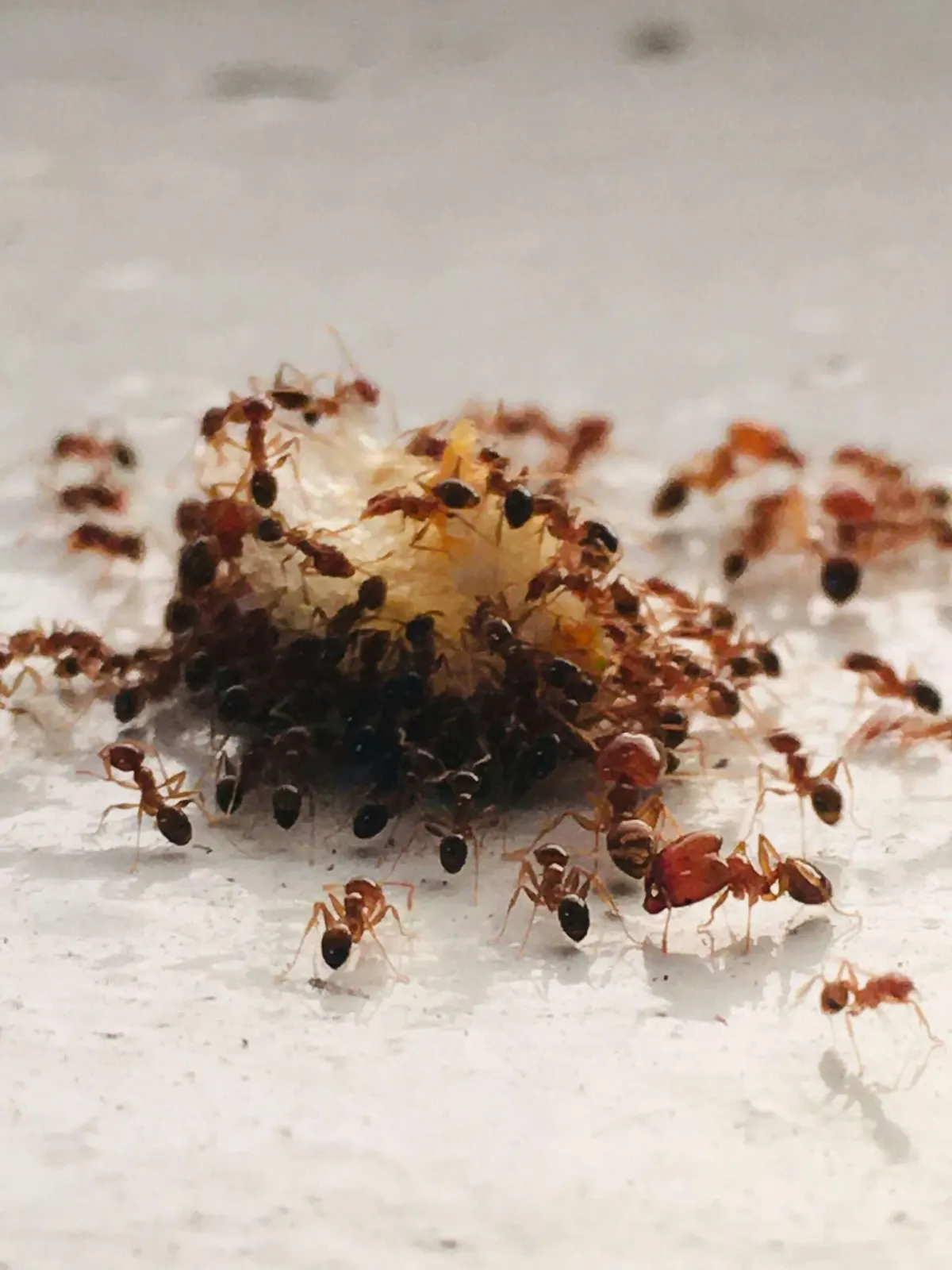
A bait works because pests carry it home. Ants take bait back to the colony and share it, so the treatment reaches the queen and the young that a contact spray on the trail never touches. It is slower than a spray, but it can wipe out the colony instead of just the trail. When a technician can find the colony, treating it directly comes first.
Fire ants show how this plays out in DFW. We treat single mounds in an open lawn one at a time. A yard that keeps sprouting mounds gets a granular bait spread across the whole lawn, the first step of the Two-Step Method that Texas A&M AgriLife describes. Inside, gel baits handle German cockroaches in kitchens and bathrooms. Rodent bait stations work as an outdoor maintenance tool after sealing, locked wherever children or pets could reach them.
Residual Sprays and Why They Wear Off
A residual spray leaves a treated band along the foundation and entry points that keeps working for a while after it dries. That band stops many crawling insects before they reach the house. It matters most before seasonal waves, like the cricket flights that hit DFW homes in late summer and fall.
Sprays come in two kinds. Repellent sprays keep pests away from a treated surface. Non-repellent sprays don't alarm insects, so ants walk through them and carry the product back to the colony. Every spray wears down with sun, rain and time, which is why exterior treatment works on a schedule. Different products suit different seasons and pests, so a year-round schedule that rotates products by season works better than one heavy treatment.
Traps and Insect Growth Regulators
Traps remove a fixed number of pests and show where activity is. For rats and mice, traps go where droppings and rub marks show up. After sealing, attics are one of the most common trap spots, while walls are not. Sticky glue monitors confirm whether brown recluses are still active in a closet or storage room.
Insect growth regulators work on the next generation instead of the adults. According to the National Pesticide Information Center, they disrupt hormones that insects have and people don't. They keep eggs from hatching or young insects from maturing, while the adults live out their lives. Fleas, cockroaches and mosquitoes are common targets. Among cockroaches, growth regulators are a German cockroach tool, used alongside gel baits to break the breeding cycle.
How Integrated Pest Management Works
Integrated pest management, or IPM, is the plan that decides which methods to use. The EPA's integrated pest management principles set out four tiers. First, set the point at which pests call for action. Then monitor and identify the pest, prevent problems, and finally choose treatments with the least risky options first. Broadcast spraying of non-specific pesticides comes last.
Texas takes IPM seriously. The Texas Department of Agriculture's school IPM page notes that state law requires every school district to adopt an IPM program and name an IPM coordinator. The same thinking works at home. Identify the pest first, seal what lets it in, and treat in a targeted way. For a typical house in Dallas, residential pest control in Dallas puts these methods together on a quarterly schedule. Homes with kids and pets can start with pet-friendly pest control, which focuses on the exterior. Whichever option fits your home, the online quote shows the price before anyone comes out.
Pest Management Methods FAQ
How many types of pest management are there?
Most guides group the methods into four types. Physical methods include sealing and traps, chemical methods include baits and sprays, biological methods use natural enemies, and cultural methods change the habits and conditions pests depend on. IPM combines them.
What are the steps in pest management?
The EPA's version has four steps. Set an action threshold, monitor and identify the pest, prevent the problem, then treat it with the least risky method that works.
Which method works best for a home?
No single method does. Sealing gaps cuts the number of pests that get in, and a targeted treatment for the pest you actually have handles the rest. Regular follow-up keeps new arrivals from becoming an infestation.