How Much Can an Ant Lift? What the Studies Show
An ant can carry up to about 9 times its body weight while walking, according to a study that pushed leaf-cutter ants to their limit. Field observers estimate ants can hoist 100 times their weight or more. The much bigger numbers online come from other tests, like an ant neck that held 3,400 to 5,000 times its weight before it broke.
On this page

How Much Can an Ant Lift and Carry
The cleanest measurement comes from leaf-cutter ants. Researchers from Stanford and the University of Florida added small weights to the leaf pieces the ants were carrying, a little at a time, until the ants hit their limit. The maximum came to 8.78 times the ant's body mass. Big and small workers could carry the same share of their own weight.
Near the limit, the ants slowed down, spread their legs wider and staggered. In the field, larger ants picked lighter loads for their size than smaller ants did, keeping more strength in reserve. A worker leaf-cutter can carry about 9 times its weight. For a 150-pound person, that would mean walking off with about 1,300 pounds.
What the Ant Strength Numbers Measure
The bigger numbers come from different tests. The table below shows four figures that turn up in ant strength claims and what each one measured.
| Number | Ant | What was measured | Who measured it |
|---|---|---|---|
| About 9 times its weight | Leaf-cutter ant | Heaviest load carried while walking | Stanford and University of Florida |
| 100 times or more | Field ants in general | Estimates based on leaves and prey ants were seen carrying | Field researchers, cited by Ohio State |
| 750 times | Fire ant | Weight held without injury inside a tower of ants | Georgia Tech |
| 3,400 to 5,000 times | Allegheny mound ant | Pulling force that broke the neck joint | Ohio State |
 Leaf-cutter ant carrying while walking | about 9 times |
|---|---|
| Field ants with leaves and prey | 100 times or more |
| Fire ant held inside an ant tower | 750 times |
| Allegheny mound ant neck pull test | 3,400 to 5,000 times |
Bar lengths use a log scale, so each step is ten times the last.
Only the first number is a load an ant carried on the move.
The famous 5,000-times figure comes from Ohio State's ant neck study. Engineers anesthetized Allegheny mound ants, glued them face-down in a centrifuge and spun them faster until the neck gave way. The neck began to stretch at 350 times the ant's weight and ruptured at 3,400 to 5,000 times. That's the strength of a joint under a pulling force, not a weight the ant picked up. The team also chose an ordinary field ant that isn't known for lifting.
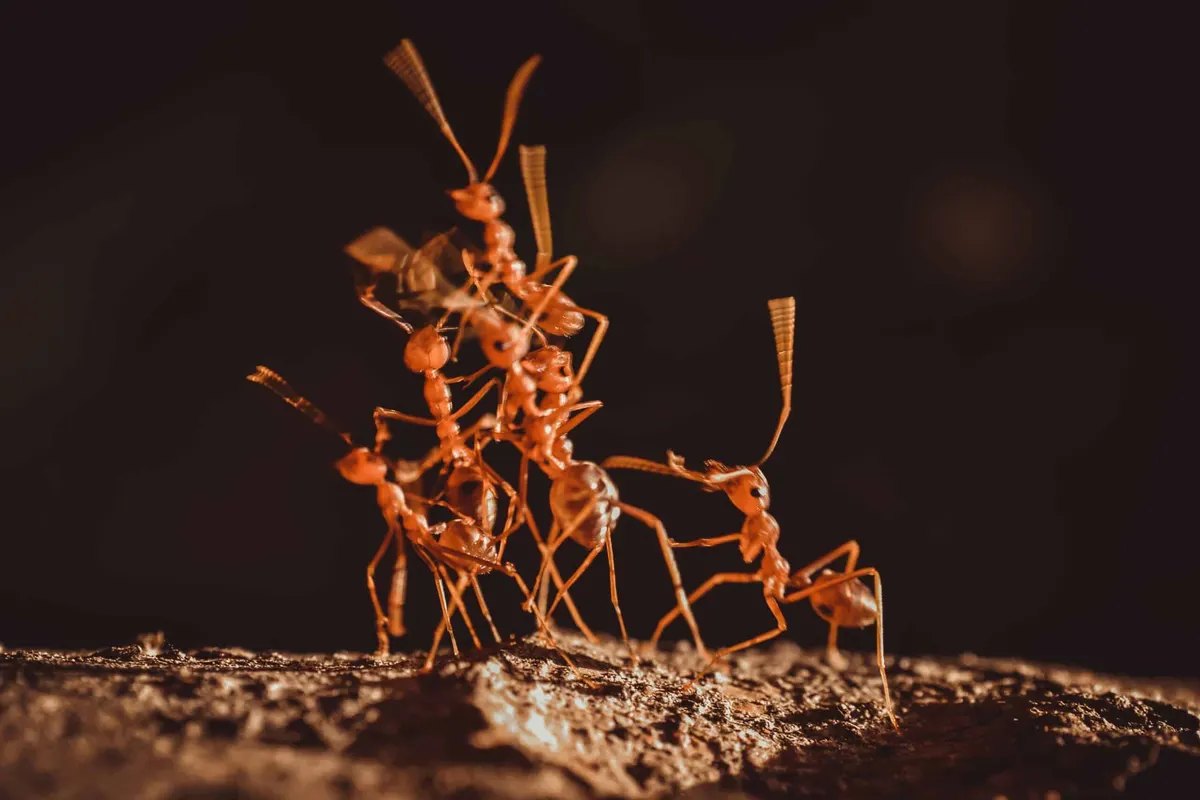
The 750-times figure for fire ants comes from a different test. In a study of how fire ants build living towers, Georgia Tech engineers found that an ant can withstand 750 times its body weight without injury. Still, the ants seem most comfortable with three ants on their backs. With more than that, they let go and walk away.
How Strong Are Ants for Their Size?
Ants are strong for their size mostly because they are small. An ant's body is so light that its muscles, tucked inside a hard exoskeleton, barely have to hold it up. Nearly all of that strength goes to the load. Your muscles, by contrast, spend much of their effort carrying you.
Size works against big animals. As a body grows, its weight increases with its volume, but muscle strength increases only with area. Double an ant's length, and it gets about 8 times heavier but only 4 times stronger. Scale an ant up to human size, and the advantage disappears.
Fire Ants and Other Strong Ants in DFW
In DFW, the ant strength you can see from the back door belongs to fire ants. An average colony holds 100,000 to 500,000 workers, and mounds can reach 18 inches tall, according to Texas A&M AgriLife's fire ant biology guide. Fire ants prefer open, sunny ground like lawns and parks. That is why their mounds pop up in the open lawn rather than along fences, often a day or two after a heavy rain.
Their teamwork is just as impressive. A colony can move several hundred feet and build a new mound almost overnight. When floods hit, fire ants link their bodies into rafts that float until they reach land, and Georgia Tech found those rafts can stay afloat for months.
Carpenter ants show their strength in wood. They don't eat it. They hollow out galleries for their nests, usually in wood that water has already softened, and carry the shavings out of the nest, which leaves piles of coarse sawdust. In DFW they also nest in trees, and ants trailing a crape myrtle near the house almost always mean a colony lives in it. Our guide to carpenter ants nesting in DFW homes explains how to tell them from termites.
Why Ant Strength Makes Baits Work
All that carrying has a purpose. Foraging workers haul food back to the nest to feed the queen and the developing brood. Baits use that habit. Workers pick up the bait and carry it home, where it reaches the queens, which a spray never touches.
Spraying a trail does the opposite. It kills the workers you can see and leaves the colony alive. Some common DFW ants, like odorous house ants, often called sugar ants, split into several new colonies when they meet a repellent spray. One kitchen trail can turn into three.
Fire ants follow the same logic. We treat a single mound on its own, but a lawn that keeps producing mounds needs bait spread across the whole yard. Our technicians identify the species first, treat the colony directly when they can find it, and use baits and non-repellent sprays that workers carry home when they can't. If a trail has reached your kitchen, see how we treat ant colonies and price a visit online.
Ant Strength FAQ
Could a human-sized ant lift a car?
No. If an ant grew to human size, its weight would rise much faster than its muscle strength, the Ohio State engineers explain. A giant ant would struggle under its own weight and couldn't carry anything like its small-scale loads.
Are ants the strongest insects?
No. Scientists at Queen Mary University of London named a small dung beetle, Onthophagus taurus, the world's strongest insect after it pulled 1,141 times its own body weight. Like the ant neck test, that pull measures something different from carrying a load.
Can an ant lift 50 times its body weight?
The 50-times figure is popular, but we found no study behind it. In the study that tested leaf-cutter ants to their limit, they carried about 9 times their weight while walking. Field observers estimate ants can hoist 100 times their weight or more, so a short lift of 50 times is plausible.