Wolf Spider vs Brown Recluse
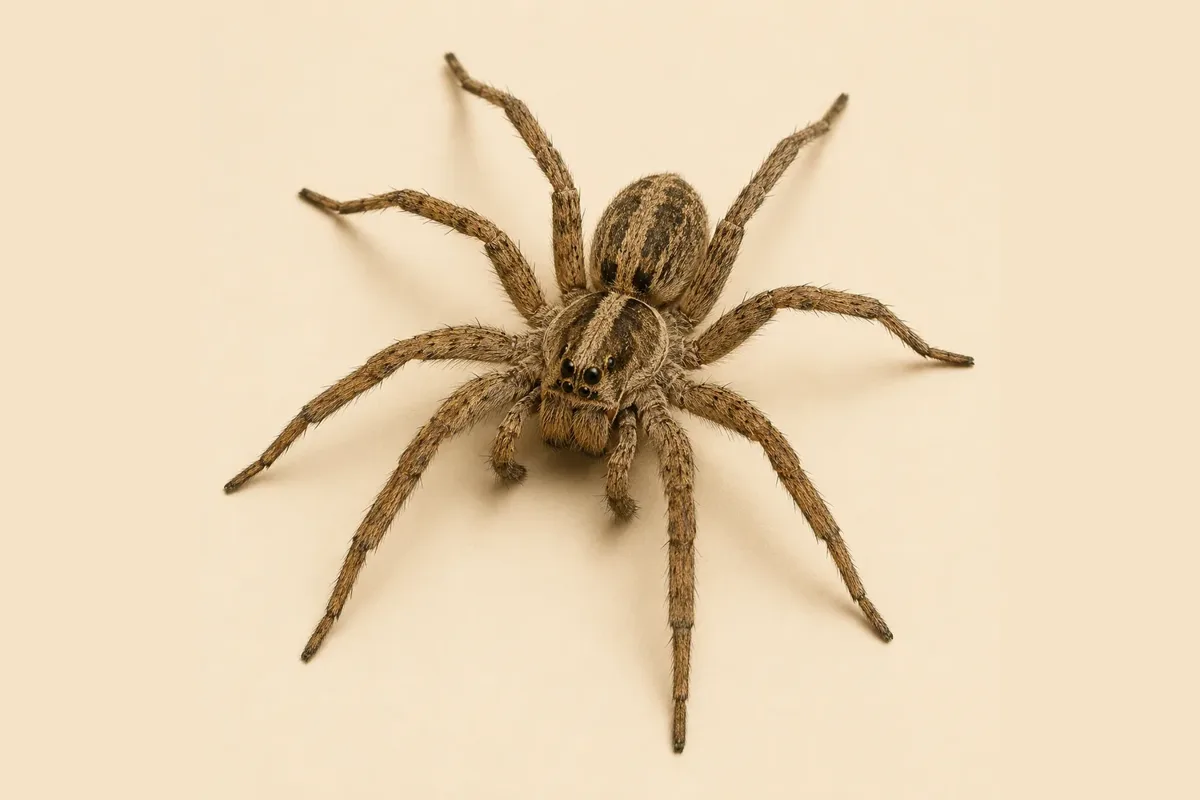
A wolf spider has eight eyes in three rows, a striped or mottled body and spiny legs that are often banded. A brown recluse has six eyes in three pairs, a plain abdomen and smooth legs of one color, and its body is no longer than about 3/8 inch. The eyes and legs settle it faster than the violin mark.
On this page
Wolf Spider vs Brown Recluse at a Glance
Both spiders are brown, both hunt at night, and both turn up indoors in DFW, so people mix them up all the time. This table lines up the clues you can check without handling the spider.
| Clue | Wolf spider | Brown recluse |
|---|---|---|
| Eyes | Eight, in three rows, with two large ones facing forward | Six, in three pairs set in a curve |
| Body length | About 1/4 to 1 inch | No more than about 3/8 inch |
| Body pattern | Dark stripes or a mottled pattern | Plain abdomen, often with a dark violin shape behind the head |
| Legs | Thick, spiny and often banded | Thin, smooth and one solid color |
| Web | None for hunting | Small, messy white or gray silk |
| Where you see it | Running across floors, near doors and lights | Hiding in closets, boxes and garages |
Check the Eyes First
Eye count is the most reliable test, and you don't need a microscope for it. Trap the spider under a clear glass, then zoom in with your phone camera. A wolf spider has a bottom row of four small eyes, two big eyes above them and two more on top of the head. A brown recluse has only six eyes, grouped in three pairs that form a shallow curve.
The violin shape varies, and many harmless spiders have dark marks in the same spot, so count the eyes first.
Wolf spiders also give themselves away at night. Their large eyes reflect light, so a flashlight held next to your face makes them shine back like a cat's eyes across a lawn or garage floor.
The violin mark is a weaker clue than most people think. UC IPM's brown recluse pest note says that a violin shape, or the lack of one, can't identify the spider. It lists five traits a true recluse must have together, and the six paired eyes come first.
Size, Legs and Body Markings
Size alone points you in the right direction. A spider with a body longer than about half an inch is not a recluse. Wolf spider bodies range from about a quarter inch to a full inch, and females outgrow males. A recluse body tops out near 3/8 inch, and its legs spread to roughly the size of a quarter or half-dollar.
Look closely at the legs next. Wolf spiders have stout legs with stiff bristles, and many show light and dark bands. Recluse legs look smooth and slender, with fine hairs and no bands or spots. The abdomen tells the same story. Wolf spiders carry stripes, chevrons or blotches, while a North American recluse never has a pattern on its abdomen.
Pick what you see in each row.
Where Each Spider Shows Up in DFW Homes
Where you find the spider says almost as much as its body. Wolf spiders live outside in leaf litter, mulch beds and lawns, and they walk in under door sweeps that have worn gaps. Texas has many species, including the striped rabid wolf spider found from East Texas into Central Texas. You usually see one alone, out in the open, often on a tile floor near the back door or garage.
Brown recluses settle indoors readily, and Texas sits well inside their home range. They tuck themselves into closets, under furniture, behind baseboards and inside the cardboard boxes stored in DFW garages and attics. You rarely see one in daylight, and a home with one recluse usually has more. In Arlington and across DFW, many homes have an attached garage packed with stored boxes, which gives recluses exactly the dark, still spaces they want.
Egg Sacs, Spiderlings and Webs
Wolf spider mothers guard their young closely, and that habit makes them easy to identify. A female attaches her round egg sac to the tip of her abdomen and drags it everywhere. After the eggs hatch, the spiderlings climb onto her back and ride there for up to two weeks or more, as the Missouri Department of Conservation's wolf spider guide describes. A spider covered in tiny babies is a wolf spider.
A recluse leaves its egg cases behind in dark corners instead. Each case measures about 5/8 inch across, and a female makes one or two a year. Recluses also spin a small, irregular web of white or gray silk that works as a hideout and an alarm line rather than a trap. Wolf spiders build no web for catching prey at all.
How Their Bites Compare
A wolf spider can bite if you grab or press it, but wildlife biologists rate the bites of North American wolf spiders as harmless to people.
A brown recluse bite is the one that matters. It often goes unnoticed at first, then turns painful and can form a blister with swelling around it. UC IPM estimates that about 10% of bites cause moderate or worse tissue damage, and a deep sore can take six to eight weeks to heal. People blame many skin infections on recluses, so keep the spider if you can and show it to the doctor. That one step makes the diagnosis far easier.
If you keep catching recluses in closets and boxes, our spider control around DFW homes targets the hiding spots as well as the bugs they eat. Homeowners in Arlington can also see how we cover their city on our pest control in Arlington, TX page.
Brown Recluse and Wolf Spider FAQ
Which is bigger, a wolf spider or a brown recluse?
Wolf spiders usually are. Many reach a body length of half an inch to an inch, while a recluse body stays at about 3/8 inch or less. A large brown spider running across the floor is almost always a wolf spider.
Is a brown spider with stripes a recluse?
No. A brown recluse has a plain abdomen with no stripes, spots or chevrons. Stripes on the back point to a wolf spider or one of the other harmless hunters common in DFW.
Do brown recluses jump at people?
No. Recluses are shy and hide during the day. Bites happen when a person presses one against the skin, such as by pulling on a shirt or rolling over onto it in bed.
A brown spider you can't place is worth a clear photo of its eyes. Ask for a price online or with a quick call, and our team will look through the closets and garage where recluses settle.