Do Jumping Spiders Bite?
Jumping spiders can bite, but they rarely do. Texas A&M entomologists say they're unlikely to bite unless cornered or handled, and their venom isn't considered dangerous to people. A bite feels like a sharp pinch and usually leaves a small, itchy red bump. In DFW they're among the most common spiders on sunny walls and windows.
On this page
What a Jumping Spider Bite Feels Like
Most jumping spider bites happen when someone pins one against skin, for example by rolling onto it or pressing it inside a sleeve or glove. The spider bites to get free. People describe a quick, sharp pinch, then a little redness, swelling and itching around the spot.
Treat it like any minor bite. UC IPM's spider pest note advises washing the bite and using ice or a cold compress to bring down swelling. It also recommends anti-itch medicine instead of scratching, which can lead to infection. Call a doctor if the bite causes an unusual or severe reaction, such as spreading redness, fever or trouble breathing.
UC IPM also points out that people and doctors often blame spiders for skin sores without any proof of a spider. The fangs of most spiders are too small to pierce adult skin. A bump you find in the morning is far more likely to come from a flea, a mosquito or an irritated hair follicle.
Are Jumping Spiders Poisonous?
No. Spiders are venomous, not poisonous, and nearly all of them use venom to subdue insects. Jumping spider venom works on flies and caterpillars and isn't considered dangerous to people. The Texas A&M AgriLife spider fact sheet names only two medically significant spiders in Texas, the brown recluse and the widow spiders.
This table compares the spiders DFW homeowners find most often, sorted by how much a bite matters.
| Spider | Does it bite people? | How serious is a bite? | Where you usually see it |
|---|---|---|---|
 Jumping spider Jumping spider |
Rarely only when pinned or handled | Mild, a pinch and an itchy bump | Sunny walls, windows, fences, patio furniture |
| Wolf spider |
Rarely if handled roughly | Mild, sore for a short time | Lawns, garages, along baseboards at night |
| Sac spider |
Sometimes when trapped against skin | Noticeable, but not medically significant | Ceiling corners and wall edges indoors |
| Black widow |
Rarely when trapped | Medically significant, see a doctor | Woodpiles, meter boxes, garage clutter |
| Brown recluse |
Rarely when pressed | Medically significant, see a doctor | Closets, attics, stored boxes |
How to Recognize a Jumping Spider
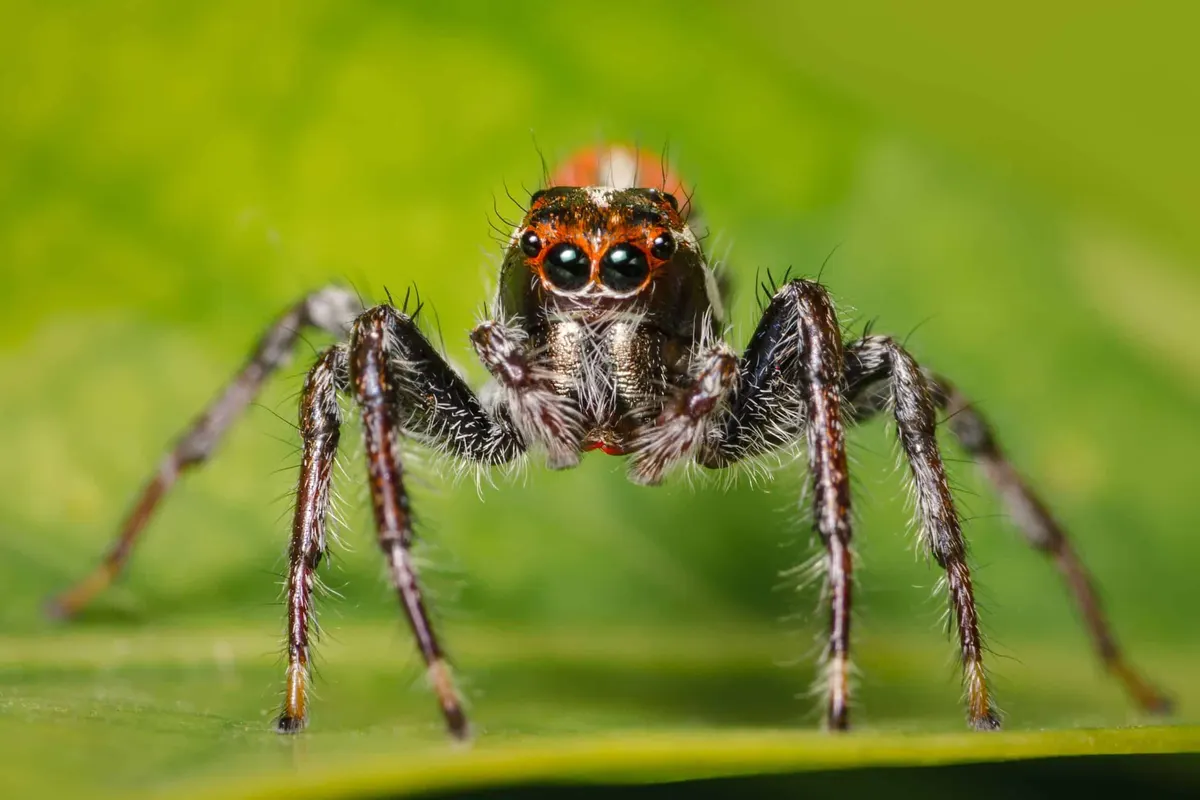
Jumping spiders are easy to tell apart from other spiders once you know what to look for. Texas A&M describes them as stocky and often brightly colored, with black and white bands, red, yellow or metallic green and blue markings. They hunt by day, move in short stops and starts, and leap many times their body length onto prey. Before each jump they attach a silk dragline, so a missed leap leaves them dangling from a thread.
The eyes give them away. A jumping spider has two very large eyes on the front of its face, and it turns to look at you when you move. A wolf spider, its most common look-alike in DFW, carries its largest pair on top of its head instead.
Both hunt without a web and both have eight eyes. A jumping spider looks at you with two big eyes on the front of its face, while a wolf spider's largest pair sits on top of its head.
The jumper most DFW homeowners meet is the bold jumping spider. It's black with a white or orange spot on its back, and its fangs often shine metallic green. Its range covers most of North America, Texas included, and it often hunts on fences, porch posts and window frames.
Why Jumping Spiders Come Inside
Jumping spiders follow their food. They hunt flies, gnats, small moths and other insects, so they collect around sunny windows where insects gather. In DFW, a warm wall facing south or west stays busy with insects for much of the year. The spiders hunting there slip in through gaps around doors and screens.
A jumping spider indoors does no harm, and many people let it work. To move one, set a cup over it, slide a sheet of paper underneath and carry it outside. If you keep finding jumping spiders and other hunters in the house, look for the insects drawing them in, since spiders rarely stay where food runs out.
When spiders keep showing up in numbers, a recurring treatment works better than a one-time spray, because the products wear down and the insects return. Our spider control for DFW homes covers the outside walls, eaves and entry points where hunters gather. Homeowners near our Southlake office can see how that local team handles it on the Southlake spider control page.
Jumping Spider Bite FAQ
Do jumping spiders bite if you pick them up?
Usually not. A jumping spider that feels threatened tends to leap away or back off. It bites only when squeezed or trapped against skin, so let it walk onto your hand rather than grabbing it.
What happens if a jumping spider bites you?
You'll feel a sharp pinch, then mild redness, swelling and itching at the spot. Wash it, cool it with ice and watch for any unusual reaction, which is rare.
Why is there a jumping spider in my house?
It followed insects inside, most often to a sunny window. Jumping spiders wander in through gaps around doors and screens while hunting, and they leave once the insects run out.
Jumping spiders are the easy part, and the insects they chase are the real story. When spiders and their prey keep finding a way in, a quote takes a minute online, or you can reach our team by phone.