
Rat Control in Dallas, TX
Exclusion comes first, so the rats inside become a finite number we trap out in about a week. Our rat control in Dallas then services exterior bait stations every quarter, with locks wherever children or pets could reach them.
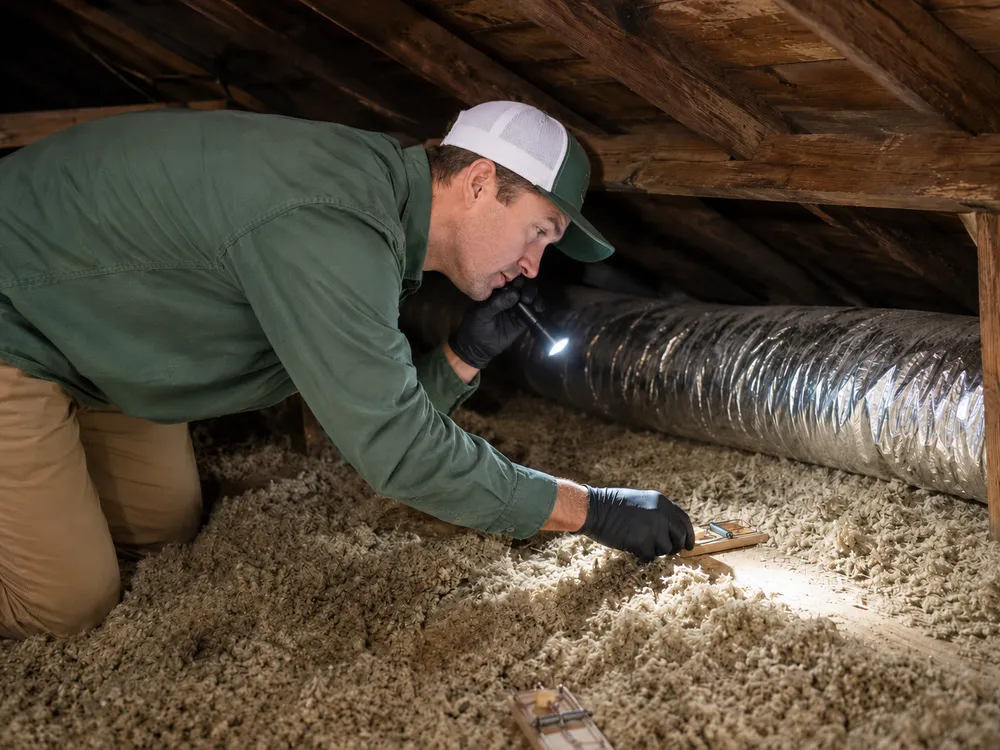
in progress
Why choose Forterra for rats in Dallas
Mature trees over older Dallas roofs and the alleys behind them let roof rats travel without ever crossing the ground, so most entry points sit at eave gaps and roofline transitions where nobody looks. Norway rats use the crawl space and utility runs below. Forterra follows those runs across shared roof spaces to where they cross, then closes them with the Zero Gap System™. Licensed TPCL #850046, free inspection for interior rodent issues.
Forterra Dallas.
Rat work in Dallas leans heavily toward roof rats, and the Dallas office traces the branches, fence lines and rooflines they use before setting a single trap.
Dallas, TX 75225
- Rating
- ★ 5.0 · 569 reviews
- Service
- Mon to Fri, 7:00am to 7:00pm
- Phones
- Phones answered 24/7
- License
- TPCL #850046
Why Rats Thrive in Dallas
Roof rats dominate rat work in the Dallas office's territory, and the tree canopy is the reason. Older neighborhoods have mature trees growing over roofs and alleys running behind properties, and a rat traveling by branch and fence line reaches a roof without ever crossing open ground. The entry points we find are usually high, at eave gaps, roofline transitions and rusted-out vent screens.
Norway rats turn up too, lower down, using the pier-and-beam sections and the utility penetrations that older homes carry. Telling them apart changes where the work goes, so identification comes before anything else. Sealing comes before trapping here, since trapping inside a building that is still open never ends the infestation. Interior rat problems get a free inspection, and we quote exclusion per home.
569+ five-star reviews.
Serving Dallas.
"Very professional work!"
"So great and awesome service!"
"Chad brown is an exceptional professional. Always on time, does a through inspection and applies insecticides exactly where needed."
"Service was quick and thorough. Wasn't home, but Cobie did a great job. If only he could have treated for bunnies;-)"
How Our Exterminators Treat Rats in Dallas
In older Dallas neighborhoods the canopy is the road in, so the entry points sit above head height where nobody looks. Sealing those changes the outcome, and trapping alone does not.
Seal entries
We close the building first. That is the fix.
We seal every entry route from the inspection with the right material for each opening. Sealing first makes the problem finite. Whatever is still inside is all we have to remove, and trap-shy rats have nowhere left to rotate to.
Trap inside
Next, traps catch the rats now locked inside.
Traps go where the activity actually shows, on the runs and rub marks, in secured stations wherever kids, pets or people could reach them. With the routes closed, most homes go quiet in about a week.
Maintain outside
Exterior bait stations keep the pressure down.
Bait is a maintenance tool, not a shortcut, tamper-resistant stations on the exterior reduce the surrounding population before it ever finds a new gap, checked and refreshed on the quarterly visit.
"You can pay somebody to trap rats in your attic every quarter forever, or you can pay once to seal the building and stop the problem at the source. Trapping is somebody else's recurring revenue. Exclusion is the actual fix. We do exclusion because it's the part that holds, the rats either find a way in or they don't, and our work is what decides that."
Where Rats Get Into Dallas Homes
Roof rats reach older Dallas homes through eave gaps, roofline transitions and rusted vent screens, while Norway rats work the pier-and-beam skirting below.
- 01
Roof and ridge vents
The roof rat's front door, worn flashing at ridge vents, reached by fence-top and tree-limb.
- 02
Gable vents
Chewed screens here mean attic nesting; re-screened after trapping.
- 03
Soffit and fascia gaps
The roofline seam opens with age; sealed with material a rat cannot chew through.
- 04
Roofline junctions
Dormer and chimney flashings are the climbing highway's on-ramps.
- 05
Garage door bottom
Norway rats walk under worn seals at night; replaced with rodent-resistant sweeps.
- 06
Sewer and utility penetrations
The Norway rat's route, slab gaps at plumbing, sealed shut.
Ready when you are. Real prices online in about 60 seconds, phones answered 24/7.
Our Rat Control Process in Dallas
We build the quote from the free interior inspection. In these older homes it usually points to roofline work rather than a gap at ground level, and the written quote follows within 24 hours.
- 01
Free interior inspection
Attic, roofline, foundation and garage. We identify the species from droppings and gnaw evidence, map the runways and find every entry point.
- 02
Transparent quote
Species, trap plan, sealing work and exact price before anything starts. We itemize trapping and exclusion separately so you can see what each costs.
- 03
Seal and trap
Sealing comes first. Every entry route closed with the right material for its opening. Traps then work the active runways inside, cleared and repositioned until the house goes quiet. No rats dying in your walls.
- 04
Ongoing monitoring
Exterior bait stations keep the surrounding population down, checked and refreshed on the quarterly Residential Pest plan. The sealed routes stay guaranteed, rats back through a sealed route, we come back free.
Dallas Rat Control FAQ
Answers below cover rats in the ceiling, shared walls, empty traps, rats versus mice and the free first assessment.
Usually from a tree or a neighboring roof rather than from the ground. Mature Dallas trees with limbs over a roofline give rats a route that never touches a foundation, which is why bait placed around the base of the house sits untouched while the noise overhead carries on every single night. The work therefore starts at roof level.
They change the job rather than complicate it. Across much of older Dallas the roof space and the service runs carry on past your wall into the building next door, so work that stops at your boundary buys a few quiet weeks and no more. We follow the route to where it crosses and close it at that point instead.
Not remotely, and this is where most companies declare a rat job finished too early. A rat treats anything new in its territory with suspicion for days on end, so an empty trap on day three measures caution rather than absence. On an older Dallas property the reading that counts comes at the end of the first week, not the start.
Look at what they leave. Rat droppings are roughly the size of an olive pit and mouse droppings the size of a rice grain, and nothing else needs measuring. Older Dallas housing gets both, though the answer changes less than people expect, because the plan is the same either way. We seal first, then trap where the droppings and rub marks show activity.
No, though there is more to close than on a newer building. What works in older Dallas construction is that the routes are visible rather than buried, so once your exterminator closes them properly they stay shut. Households that seal instead of trapping indefinitely generally find the problem does not return at all after the first year.
No, not where the problem is rodents inside the structure. That one assessment sits outside the usual quote-first arrangement on purpose. Your exterminator identifies the species, traces the way in and shows you the point of entry, and you then make the treatment decision with evidence in hand rather than a guess about what is up there.
Everything caught leaves with your exterminator, and so do the nesting material and droppings wherever a hand can reach them. Leaving that in place produces an odor problem and then a mite problem soon after, so clearing it is not optional. If something sits behind finished work where nobody can reach it, we tell you exactly that rather than leave you to notice.
Around three weeks in a typical case, spread over two or three appointments. The animals set the pace rather than the schedule. Sealing and setting happen first, the trapping itself usually runs about a week once suspicion of new objects wears off, and a final visit confirms it. Cutting that short is why some houses repeat it the following year.
Rat Control near Dallas.
Same treatment and the same guarantee from the same offices. See the DFW rat control overview →
Start at $49/mo.
Quote in 60 seconds.
No phone call. No credit card up front. See the real price for your home, pick a start date, and a technician will be at your door in about two business days.
- ✓Quarterly Zero Gap treatment
- ✓50+ pests covered
- ✓Free re-treats between visits
- ✓Licensed W-2 technicians, never subcontractors
- ✓Flexible contracts
- ✓Money-back guarantee