
★★★★★
"Miles was thorough, professional and friendly. He did a great job!"
The leak feeding them is traced before the nest is treated, because one without the other fails. Carpenter ant control in Dallas handles both, then seals the entry point in your wall behind it.
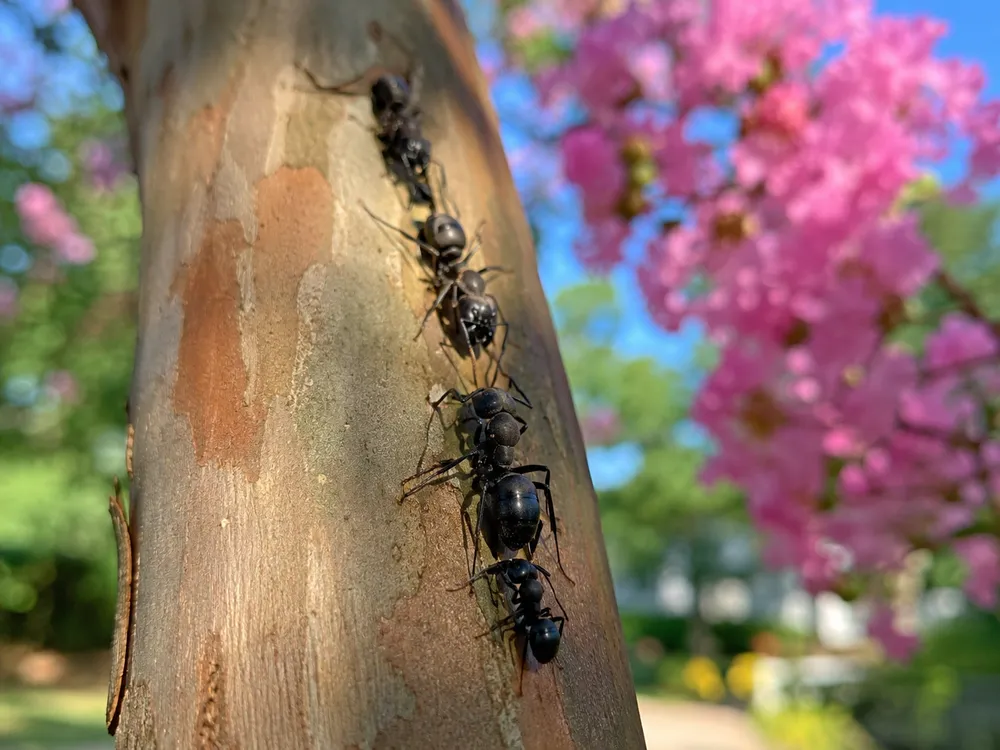
Carpenter ants need wood that water has already softened, and in your older Dallas home that usually means a slow leak behind a wall or under a porch that nobody has found. Treating the ants leaves the damp timber sitting there waiting for the next colony. Forterra finds the water source first, treats the nest, then seals the entry with the Zero Gap System™. Licensed TPCL #850046, with the Forterra money-back guarantee.
The Dallas office sits inside the city it services and covers forty-three cities and neighborhoods from there, which is why a route is a weekly run rather than a drive-in. W-2 technicians, never subcontractors, every visit logged to the property, and the ★ 5.0 rating across 548 Google reviews belongs to this office alone.
Carpenter ants in the Dallas office's territory follow moisture into older timber. Mature trees with dead limbs, fence posts that have been in the ground for decades, and the parts of a house where water has been getting in quietly, a leaking gutter line, a window sill, the roof of a detached garage, are where the nest actually sits. The ants seen indoors are usually foraging from there.
They tunnel through wood rather than eating it, which is why the damage stays hidden and why sawdust below a hole matters more than the ants themselves. Treating the trail does nothing to the colony. We find the nest, deal with it, and then talk about the water that made that timber attractive in the first place, because without that the next colony arrives eventually.
"Miles was thorough, professional and friendly. He did a great job!"
"Casey did a great job"
"Did amazing job, didn't even have to be there. It went super smoothly. Always happy with their work."
"Great service"
The ants you see are foragers. Treating them changes nothing, because the colony is in timber that has already taken water somewhere on an older Dallas property.
Wet wood is the map. We follow it.
Carpenter ants favor wood softened by moisture, leaky window headers, deck connections, roof eaves, bath traps. The inspection follows the moisture map, because that is where the galleries are.
Parent colony, satellite nests, one connected treatment.
A carpenter ant infestation is a network. A parent colony, often outdoors in a stump or fence, plus satellite nests inside the structure. Targeted non-repellent treatment reaches the galleries and moves colony to colony. Killing foragers alone changes nothing.
The moisture fixes are the prevention plan, in writing.
You get a written list of the moisture conditions we found, gutter overflows, grade-level wood contact, plumbing weeps, because treated wood that stays wet eventually invites the next colony.
Sawdust below a small hole in a garage rafter, a fence post soft at the base, and a gutter line that has been overflowing for seasons.
Overflowing gutters soak the soffit; softened framing here is prime satellite-nest wood.
The first wood wet in every storm, and the most common frass point we find.
Failed caulk lets water into sills and headers; rustling here at night is diagnostic.
Foraging routes in and out of wall voids follow the brick line's openings.
The ledger board and rail posts stay damp against the house, classic parent-colony territory.
Ground-contact posts wick moisture year-round; probing them is part of every inspection.
Ready when you are. Real prices online in about 60 seconds, phones answered 24/7.
We find the nest, deal with it, then talk about the water that made that timber attractive. Without that second part another colony arrives eventually.
Start with the number. The online tool prices carpenter ant work in about a minute, and the phone team matches it. Structural jobs that need gallery work are scoped before the first visit, in writing.
The structure, attic, deck connections, stumps and fences are examined to confirm carpenter ants rather than termites, and to map both the nests and the moisture feeding them.
Gallery injections and non-repellent perimeter work that reaches the parent colony and every satellite, not just the ants you see.
Renewed activity between visits is treated again at no cost. Structural work is warranted in writing, with the money-back guarantee backing the service itself.
If you don't see yours, call (972) 349-1621 or text us, a human will answer.
Water that has already softened the timber. They do not eat wood, they hollow out what is damp enough to excavate, so their presence points at a leak rather than at the ants themselves. In an older Dallas property that is frequently a slow failure behind a wall, under a porch or around a window that has been quietly wetting framing for years.
Two things give them away. They are considerably bigger than the ants trailing across a kitchen counter, usually black, and what collects beneath their work is coarse shavings rather than the fine grit a nest in soil throws up. They also work at night and head for wet wood, not for food left out on a Dallas worktop overnight.
Half of it, at best. The colony goes and the damp timber stays exactly where it was, ready for whatever arrives next. So the sequence on an older Dallas house runs the other way round: find the leak first, then treat the nest, then shut the route in. Leave out the first step and the same call comes again.
Nothing like what termites do, though it is not something to sit on. They tunnel through wood already softened rather than eating it, so the damage stays slow and fairly contained. On an older Dallas property the real worry is the water that softened it, which will be doing its own harm whether or not an insect ever turned up.
Beneath windows, at any wall a gutter spills onto, where a porch or deck ties into the building, and at roofline junctions that shed water poorly. Those are the places an older Dallas house holds damp once it gets in. A technician goes through all of them plus a number of voids that cannot be seen from outside at all.
Finding the nest and treating it where it sits, then closing the way in behind it. If the nest is inside a cavity, the material goes into the cavity. Spraying the ants crossing a Dallas floor removes foragers only, and a colony replaces those as fast as they disappear, which is why nothing seems to change on the surface.
A week or two from the nest being treated, in most cases. Where movement carries on past that, a satellite nest is usually involved and there is a second wet spot nobody has traced. Say so rather than waiting; the follow-up is inside the plan and the second fault tends to be found faster than the first one was.
Occasionally, and it gets said plainly when so. If the water is arriving through a seal or a flashing that genuinely needs rebuilding, anything sealed as pest work holds the line rather than solving it. What is worth having is the location pinned down and shown to you, because it makes the discussion with a Dallas contractor a very short one.
Same treatment and the same guarantee from the same offices. See the North Texas carpenter ant control overview →
No phone call. No credit card up front. See the real price for your home, pick a start date, and a technician will be at your door in about two business days.